


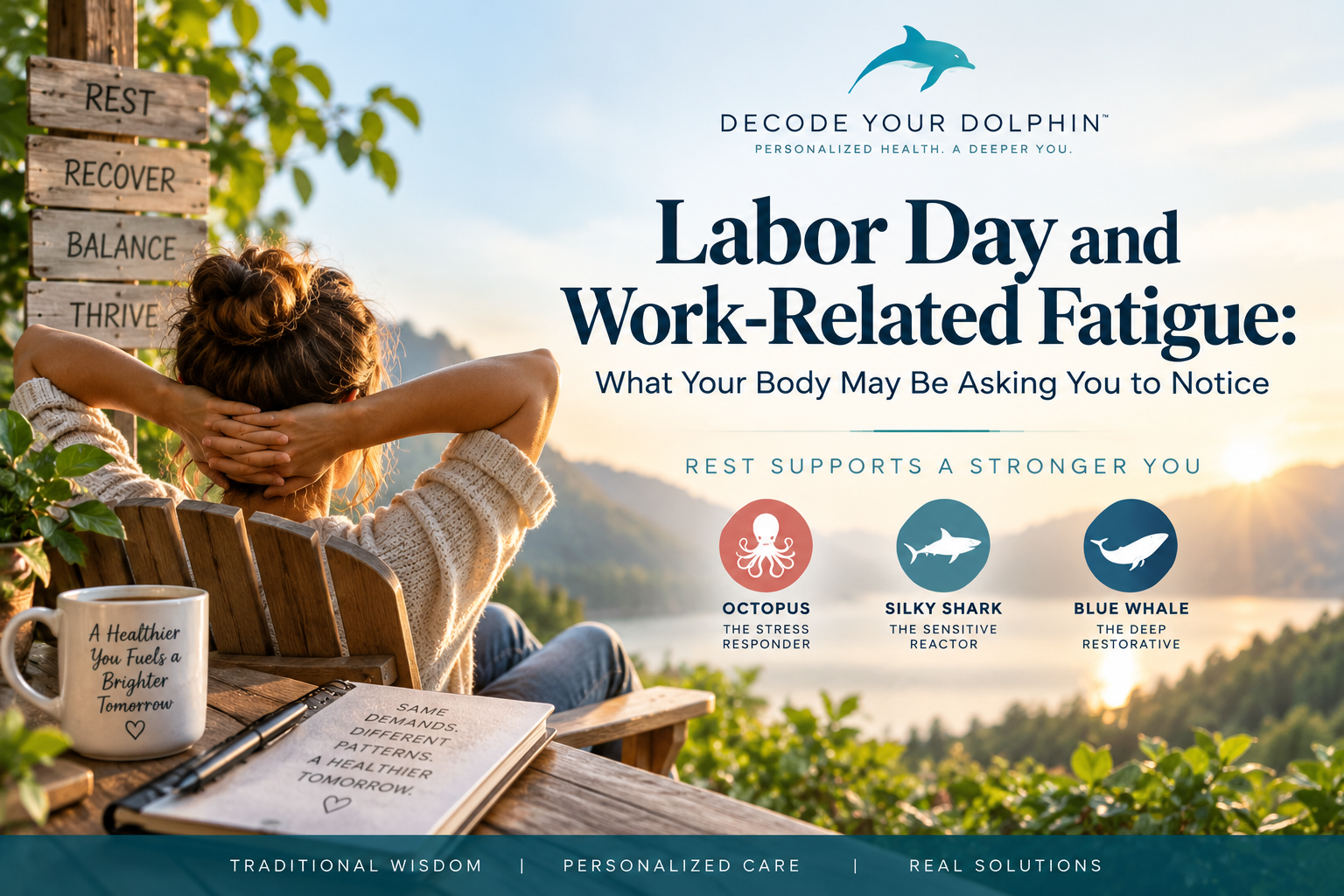
Labor Day and Work-Related Fatigue: What Your Body May Be Asking You to Notice
Labor Day is supposed to be a break from work. But what happens when your body stops working and your mind doesn’t?
Maybe the inbox is finally quiet. The groceries are waiting. There’s a cookout on the calendar. Yet your shoulders are still tense, your thoughts are still moving, and the body that carried you through the week hasn’t received the message that work is over.
That feeling can be more than simply having a busy week.
Work-related fatigue can develop when physical or mental demands begin to outpace opportunities for adequate sleep, recovery, and restoration. It doesn’t always look like falling asleep at your desk. It can show up as difficulty concentrating, irritability, slower thinking, tension, poor sleep, or simply feeling as though your energy reserves aren’t refilling. NIOSH notes that fatigue can reduce attention, short-term memory, reaction time, and judgment.
Labor Day gives us an opportunity to ask a different question:
How well are you actually recovering from the work your body does every day?
Labor Day Was Always About More Than a Day Off
The first Labor Day holiday was celebrated in New York City on September 5, 1882. By 1894, Congress had established the first Monday in September as a national holiday honoring American workers and their contributions.
More than a century later, the nature of work has changed considerably.
Not all labor happens at a desk, in a clinic, or on a job site.
It may look like caring for an aging parent, raising children, managing a household, serving patients or clients, remembering what everyone needs, carrying a family’s worries, or holding life together during a difficult season.
And beneath all of that is another kind of labor:
the work your body performs continuously.
Even when you stop moving, your body doesn’t simply clock out.
What Is Work-Related Fatigue?
Work-related fatigue isn’t necessarily the same thing as feeling sleepy after one long day.
NIOSH describes workplace fatigue as something that may be associated with nonstandard schedules that shorten or disrupt sleep. Stress, physically or mentally demanding work, and working in hot environments can also contribute.
The longer you’ve been awake and the less quality sleep you’ve had, the greater the likelihood of fatigue. Time spent continuously performing demanding tasks can contribute as well.
This matters because recovery isn’t empty time.
Sleep supports attention and memory and is associated with cardiovascular and metabolic health.
Long or irregular work hours can also disrupt sleep and circadian rhythms while reducing the time available for recovery.
But there’s an important distinction:
Not all fatigue is work-related fatigue.
Persistent fatigue can have many possible contributors. If fatigue is new, severe, unexplained, persistent, or worsening, it deserves appropriate medical evaluation rather than assuming stress or overwork is responsible.
Why You Can Stop Working Without Feeling Recovered
This is where things become interesting.
You can physically leave work at 5:00 PM while mentally remaining there until midnight.
Or you can sleep eight hours and wake up feeling as though your reserves never completely refilled.
Recovery isn’t simply the absence of activity.
It involves the body’s ability to move between periods of demand and periods of restoration.
NIOSH research on long and irregular work hours highlights this relationship: disrupted sleep, circadian disturbance, prolonged demands, and insufficient recovery opportunities can all contribute to fatigue.
A Traditional Chinese Medicine practitioner may approach the same complaint using a different framework.
They might ask:
When is your fatigue strongest?
Can you settle after the day is finished?
Does eating change your energy?
Does stress make the fatigue worse?
Do weather, movement, or sleep change the pattern?
Does rest actually restore you?
Or do you wake feeling that your reserves never refilled?
These questions don’t replace biomedical evaluation. They’re part of a traditional pattern-recognition approach intended to organize observations about how symptoms behave.
A Traditional Chinese Medicine Perspective on Rest and Recovery
Traditional Chinese Medicine has long placed importance on rhythm—periods of activity balanced by periods of restoration.
One classical passage from the Huang Di Nei Jing Su Wen describes people whose eating and drinking were moderate, whose rising and resting followed regularity, and who avoided excessively taxing themselves.
The language is ancient, but the question remains remarkably relevant:
Do effort and recovery still alternate in your life, or has effort become a tide that only comes in?
Think about the ocean.
The tide doesn’t apologize for going out.
Its retreat is part of the same movement that allows it to return.
Your body also operates through rhythms of activity and restoration. Rest isn’t necessarily the opposite of productive work. It is one of the conditions that can make continued work possible.
And this is where Decode Your Dolphin looks at fatigue a little differently.
Three Decode Your Dolphin Patterns Behind Work-Related Fatigue
Two people can work the same number of hours and describe themselves as “exhausted,” yet experience that exhaustion very differently.
One can’t switch off.
Another performs well but crashes afterward.
Another feels depleted before the day has even begun.
In Decode Your Dolphin, metabolic archetypes are used as pattern-recognition shorthand, not medical diagnoses. They help organize differences in how people appear to respond to stress, metabolic demands, and recovery.
For this conversation about work-related fatigue, three patterns are particularly interesting.
Octopus: When Your Body Stops Working but Your Mind Doesn’t
The Octopus may finally sit down at the end of the day only to discover that the mind has opened a second shift.
Tomorrow’s problems.
An unfinished conversation.
An email that needs answering.
Something that happened three days ago.
Something that might happen next week.
From the outside, this person may look extremely capable and organized. Internally, however, they may describe themselves as “wired but tired.”
From a physiology perspective, inadequate recovery and disrupted sleep can contribute to fatigue, difficulty concentrating, and changes in cognitive performance.
From a TCM perspective, a practitioner might explore patterns traditionally described as constraint—a way of organizing observations in which pressure seems to keep the system braced even after the immediate demand has passed.
A gentle clue: Your body is off the clock, but your mind is still working.
Silky Shark: When the Cost of Stress Arrives Later
The Silky Shark often gets through it.
The deadline gets finished.
The workout gets done.
The family obligation is handled.
The social event still happens.
In the moment, everything may appear manageable.
The cost comes later.
Brain fog. Irritability. Restless sleep. Headaches. Or simply needing much longer than expected to feel like yourself again.
This is an important distinction because being able to perform does not necessarily mean you’ve fully recovered.
Insufficient or poor-quality sleep can affect attention, memory, mood, and metabolic health.
A TCM practitioner might describe this pattern using concepts involving both constraint and depletion: the person can still generate momentum, but returning to baseline seems to take longer.
A gentle clue: Yesterday’s effort is still present in today’s body.
Blue Whale: When Your Reserve Doesn’t Seem to Refill
The Blue Whale can look very different.
There may be no obvious “wired” feeling.
Instead, ordinary demands begin to feel unusually heavy.
A free Saturday isn’t spent finally enjoying freedom. It’s spent recovering enough to face Monday.
The instinct may be to tell yourself:
“I need to push harder.”
But the more useful observation may be:
“I don’t seem to have the reserve I used to have.”
In TCM terminology, a practitioner might explore patterns described as Qi deficiency or Kidney deficiency. These are traditional categories used within Chinese medicine; they should not be interpreted as biomedical diagnoses or laboratory findings.
And because persistent fatigue has many possible medical causes, a pattern like this deserves appropriate clinical evaluation when symptoms are ongoing, unexplained, severe, or worsening.
A gentle clue: Even small demands seem to draw from a reservoir that isn’t refilling.
Which Work-Related Fatigue Pattern Sounds Most Like You?
You may recognize yourself immediately.
Or you may see pieces of more than one.
That’s expected.
Decode Your Dolphin archetypes aren’t rigid personality categories, and they aren’t diagnoses. Patterns can shift with stress, sleep, nutrition, activity, illness, environment, season, and recovery.
Instead of asking only:
“Why am I tired?”
we’re interested in asking:
“What does my fatigue actually look like?”
When does it happen?
What happened before it?
What improves it?
What makes it worse?
And perhaps most importantly:
Does rest restore you?
Those observations can provide useful information to discuss with your healthcare practitioner.
Two Gentle Ways to Support Recovery
You don’t need to transform your entire routine this Labor Day weekend.
Start by observing.
1. Track Your Recovery Pattern for Three Days
Pause three times each day: late morning, late afternoon, and evening.
Briefly note four things:
- Your energy
- Your physical tension
- Your mental pace
- Whether rest noticeably changes how you feel
Don’t try to diagnose yourself.
Look for patterns.
An Octopus may notice difficulty downshifting.
A Silky Shark may notice delayed consequences after periods of high demand.
A Blue Whale may notice that the reserve already felt low when the day began.
The goal is information.
2. Protect 10 Minutes of Recovery Before You’re Exhausted
Don’t wait until you’re completely depleted.
Choose ten quiet minutes earlier in the day and do one simple thing.
Sit outside.
Drink some water.
Put your feet up.
Step away from your phone.
Breathe without simultaneously answering messages.
The purpose isn’t to become exceptionally good at relaxing.
It’s to create a small, repeatable transition between effort and recovery.
NIOSH similarly emphasizes adequate rest and recovery as important parts of managing fatigue associated with demanding or nonstandard work schedules.
You Don’t Have to Earn the Right to Recover
As a three-time Ironman triathlete, I learned that stopping for water, minerals, nourishment, or care isn’t abandoning the race.
Those moments are part of how continuing becomes possible.
Everyday life asks for some of the same wisdom.
There is no prize for fighting your body.
If your body is asking for recovery, the answer doesn’t always have to be more discipline, another cup of coffee, or forcing yourself through another task.
Sometimes the first step is simply recognizing the pattern.
Pattern Recognized
Your worth does not depend on how long you can labor without rest.
The Octopus may need help ending the inner shift. For the Silky Shark, recovery may mean noticing the cost that arrives later. Meanwhile, the Blue Whale may need permission to rebuild slowly.
Caring for your body does not mean stepping away from your purpose. It helps protect your capacity to fulfill it.
There is no prize for fighting your body. Small, steady changes can create meaningful momentum.
Your body is communicating, not betraying you.
If you’d like to better understand your individual pattern, start with the Decode Your Dolphin assessment. You can also schedule a complimentary 10-minute conversation with Dr. Cynthia Clark to discuss what your pattern may be asking you to notice.