


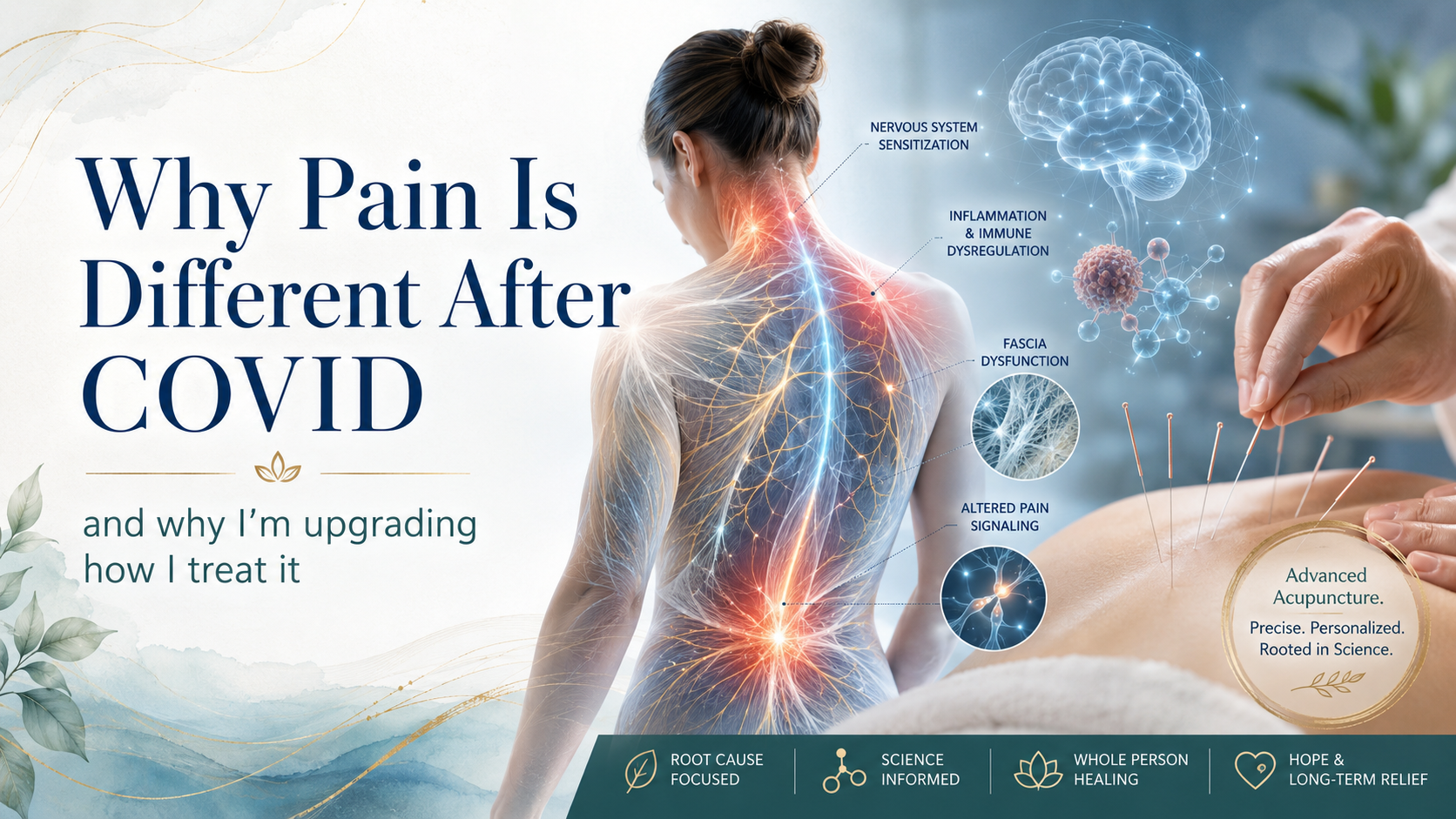
Why pain is different after COVID and why I’m upgrading how I treat it
Over the past few years, many people have noticed that pain feels “different” after COVID – more widespread, more easily triggered, slower to calm down, and often strangely disconnected from what the X-rays and MRIs show. Research on chronic pain and neuroplasticity shows that persistent inflammation and immune activation can sensitize the nervous system, expanding the brain’s “map” of pain and making it easier for normal signals to be interpreted as threat. The spike protein and immune response appear to play a role in ramping up these pathways in some people, which means that post-COVID pain is often as much a “wiring and signaling” problem as it is a local tissue problem.
In Decode Your Dolphin language, it’s as if your inner “dolphin pod” of nerves and immune cells has been living on high alert since COVID – scanning for danger, over-protecting, and sometimes sounding the alarm when you’re actually safe. That helps explain why some people hurt “everywhere,” why pain flares after minor stressors, and why imaging often doesn’t match the level of suffering.
Because of this, therapies that can calm and reorganize the nervous system are more important than ever. Dr. Joseph Audette’s work as an MD who is an acupuncture teacher to Harvard physicians has helped demonstrate how acupuncture can modulate central sensitization, change receptive fields, and even reshape pain-related brain networks over time. That is why I’ve chosen to focus on learning the AcuMed Fascial Node method in person: it is a hands-on way to communicate directly with the nervous system through very specific fascial points, with the goal of quickly changing pain signaling instead of just chasing symptoms at the surface. In Decode Your Dolphin terms, this is one of the ways we help your pain pod remember how to swim in calmer waters again.
What is Fascial Node work?
Most acupuncture styles already work with muscles, tendons, ligaments, and fascia, using the more than 300 classical points mapped along meridians. Fascial Node work goes a step deeper by focusing on special “confluent” regions in the fascial network – intersections where multiple layers of muscle, fascia, and nerve input meet and where the nervous system seems to be especially tuned in.
Many of these fascial nodes live near well-known acupuncture points (like GB 20, BL 10, TW 15, SI 13 in the neck and upper back; BL 25 and GB 25 in the low back and flanks), but others do not have traditional names despite being clinically powerful. In Decode Your Dolphin, I think of these nodes as little reefs in your pain pod: places where signals from your muscles, fascia, and immune system converge and sometimes get stuck firing.
In practical terms, the session starts with very careful palpation: searching along fascial lines for the small, dense, hypersensitive nodes that reproduce your familiar pain or dramatically change it when pressed. These nodes are then gently needled to send a clear, high-value signal into the nervous system, with the aim of “re-mapping” an overactive pain circuit rather than just locally relaxing a tight muscle. This is what makes the method feel both precise and neurologically oriented – we are asking your dolphin pod to update its map, not just poking the sore spot.
If you’ve worked with me through Decode Your Dolphin, you can think of Fascial Node work as the nervous-system twin of decoding your metabolic archetype: together, we’re identifying the exact places where your fascia, muscles, and nerves are over-talking, and then helping that local pod come back into rhythm with the rest of you.
“Like a nerve block” – but the secret is the point
If you have heard of a “nerve block,” you may know it as an injection near a nerve using anesthetic or steroid medication to interrupt pain signals. What Dr. Audette emphasized – and what really struck me – is that the clinical magic is not only in the medication, but in the exact point chosen along the nerve and fascial pathway. In other words, the targeting matters at least as much as what is injected.
In Fascial Node acupuncture, we apply that same logic without focusing on pharmaceuticals: the “block” effect comes from stimulating the right fascial node at the right depth and angle so that a key branch of the nervous system receives a potent, organizing signal. This is why a single well-chosen node can sometimes shift pain and movement within minutes. It is also why it was so important for me to travel and feel these points taught directly by a Harvard physician acupuncture instructor – this level of precision is hard to learn from slides alone.
Through the Decode Your Dolphin lens, this is a form of signal hygiene. We’re not trying to “turn off” your nervous system; we’re helping it refine which signals deserve a full alarm and which can be safely filed away as background noise. For my Octopus-style patients, whose stress systems are already wired and tired, this nuance really matters.
Case stories: how the pain pod responds
Post-COVID neck pain easing in minutes (Sea Turtle–Octopus mix)
One person came in with persistent neck pain and tightness that had worsened in the past few years, along with trouble concentrating and sleeping from the constant tension. Their posture showed forward head carriage and elevated shoulders, and palpation revealed exquisitely tender fascial nodes at the upper trapezius, levator scapulae, and deep nodal areas near GB 20 and BL 10. These nodes reproduced not just the local neck pain, but also the familiar band of discomfort up toward the skull base.
During treatment, a small number of these key nodes were needled and gently stimulated, and within a few minutes the patient reported the neck pain dropping from “intense and sharp” to “background awareness,” with a sense that their head could sit more naturally over the spine. On re-testing, rotation and side-bending improved, and the tenderness in the nodes decreased markedly when palpated again. This kind of rapid change is consistent with the idea that we are influencing a sensitized segment of the nervous system as much as we are treating the muscle tissue itself.
Decode Your Dolphin view: this person felt like a Sea Turtle–Octopus hybrid – slower thyroid/metabolism underneath, with a wired, stressed nervous system on top. Their pain pod wasn’t “misbehaving”; it was doing overtime. When we contacted the right nodes, we gave that pod permission to stand down, just a little.
Shoulder pain and hidden nodes (Pufferfish–Octopus flavors)
Another person, also in the past few years (post COVID), had nagging shoulder pain that flared with certain movements and sleep positions, despite imaging that did not show a major tear. Postural assessment revealed internally rotated shoulders and a tendency to round forward, and palpation quickly identified fascial nodes in the supraspinatus and infraspinatus, as well as deep nodal tenderness near the pectoral region and SI 10–11 behind the shoulder. Some of these points did not correspond to classic textbook shoulder points but matched the fascial node map and reproduced the patient’s exact pain.
By selectively needling the most reactive nodes – both on the back of the shoulder and in the front, where shortened pectoral fascia was contributing to impingement – the pain arc during elevation reduced dramatically in the same session. The patient could raise the arm higher with less “pinching” and noted the shoulder felt “lighter and more connected,” which again fits with the idea of changing how the nervous system is coordinating the scapula and glenohumeral joint, not just loosening one tight spot.
Decode Your Dolphin view: this is a classic Pufferfish–Octopus pattern – hormone and liver-related tension meeting chronic stress. The shoulder wasn’t just a local problem; it was a busy intersection in a pod that had been juggling too many signals for too long.
Low back pain and the pelvic chain (Walrus–Blue Whale currents)
A third person struggled with chronic low back pain that started about 10 years ago but worsened in the past 3 years, especially when standing or walking for longer periods. Exam showed pelvic tilt and asymmetry, and palpation of the low back alone did not fully explain the pattern. When the fascial node map for the back and hips was applied, strongly reactive nodes appeared not only at BL 25 and GB 25 in the lumbar region, but also in the gluteus medius/minimus, piriformis, and tensor fasciae latae along the outer hip and thigh.
Treatment focused on those hip and pelvic fascial nodes that mirrored the alignment pattern, and after needling, the patient’s lumbar extension and side-bending improved with less guarding, and their “sciatica-like” referral eased. This is in line with Dr. Audette’s teaching that many low back pain patterns reflect dysfunction across a multisegmental network of muscles and fascia, and that addressing the right nodes in the chain can reduce the “volume” of pain the nervous system is amplifying.
Decode Your Dolphin view: this looked very Walrus–Blue Whale – metabolic load on the midsection plus aging-related depletion in the deeper reserves. The pelvic chain became a place where the pod was shouting; once we treated the chain, not just the sore low back, the volume dropped.
Where the Octopus archetype fits: your stress-sensitive pain pod
Many of you reading this live in an Octopus phase: high-functioning, multitasking, often “on” for everyone else, and quietly running your stress chemistry hot. In lab terms, this shows up as HPA axis dysregulation – cortisol rhythm off, DHEA drifting down, sleep choppy, energy swings between wired and wiped.
From a Decode Your Dolphin perspective, Octopus types have a pain pod that is exquisitely sensitive to context. Long-term stress depletes Kidney Yin and Yang and disturbs the Heart Shen, leaving the nervous system less buffered, more jumpy, and more likely to interpret normal signals as emergencies. Post-COVID inflammation pours fuel on that fire.
This is why, for Octopus-pattern patients, we don’t just needle fascial nodes and send you back into a 10-meeting day. We pair node work with:
Nervous-system-soothing movement (restorative yoga, tai chi, mindful walks) that builds serotonin and calms overactive stress circuits.
Food that steadies cortisol instead of spiking it – warm, easy-to-digest proteins and complex carbs, not extreme fasting or crash dieting.
Sleep and boundaries work so your pod has actual off-duty time.
AcuMed Fascial Node sessions become one of the ways we tell your Octopus nervous system, “You’re allowed to come out of fight-or-flight now.”
Why I’m excited enough to keep traveling and learning
The post-COVID era has made it clear that pain is not just about local tissue strain; it is deeply about how the nervous system, immune system, and fascia are talking to each other. The AcuMed Fascial Node method gives a practical, hands-on way to converse with that system: find the true confluent points, engage them precisely, and watch how the body and brain respond in real time. Seeing neck, shoulder, and low back pain soften in minutes when the correct fascial node is contacted – especially in people who have been hurting for months or years – is both humbling and energizing.
In my Decode Your Dolphin work, we do this metabolically with labs and archetypes; in Fascial Node work, we’re decoding your pain pod – helping your inner dolphin and its pod of nerves remember how to swim in calmer waters again. That is why I took half a week away from work to study this in person with a Harvard MD acupuncture instructor, building on my prior online postgraduate training: because patients deserve approaches that match the complexity of what they are living through now. And honestly, as a clinician, it is thrilling to learn a method that is at once deeply scientific, palpation-based, and profoundly human.