


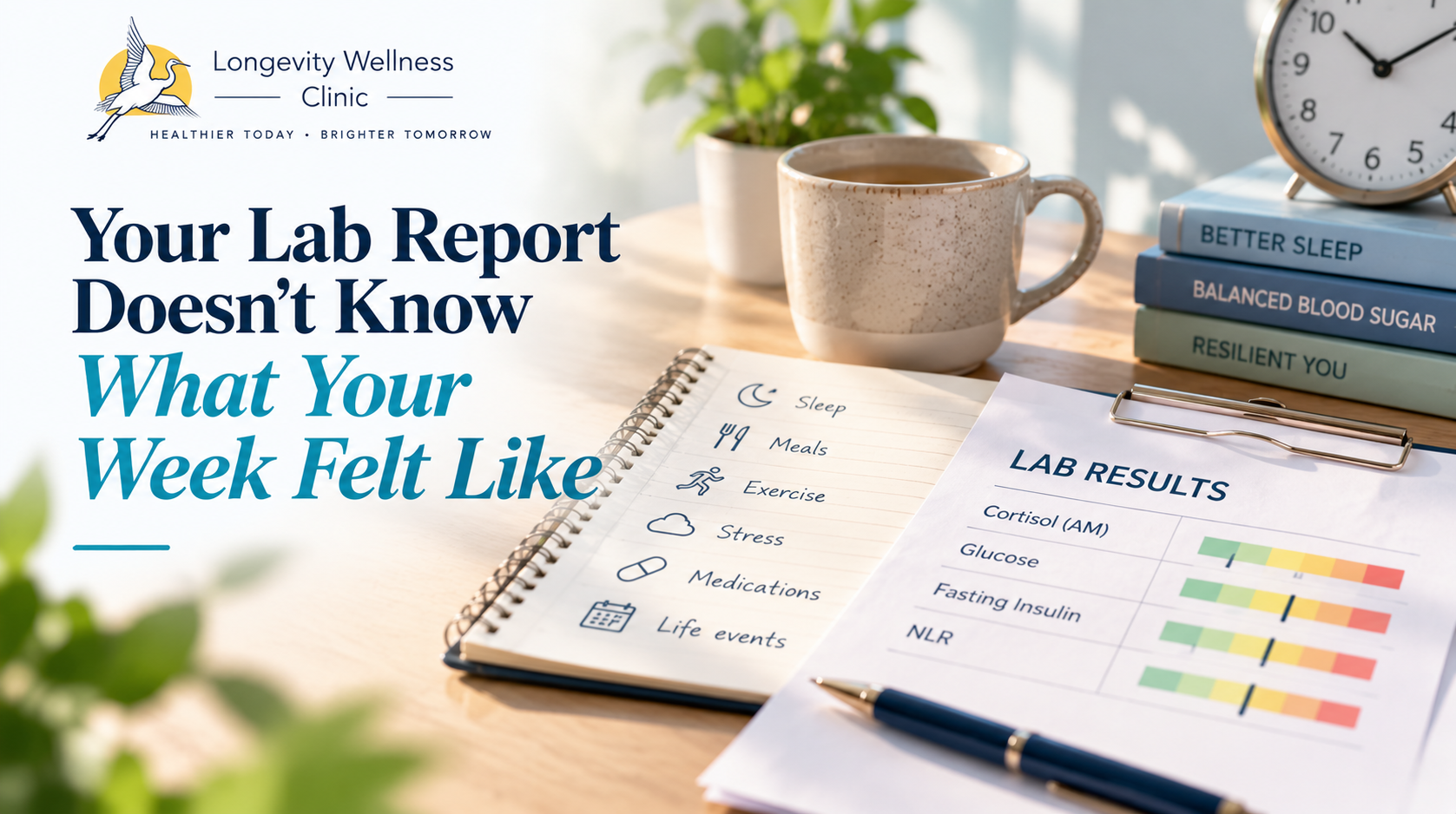
Understanding Lab Results: Your Lab Report Doesn’t Know What Your Week Felt Like
The number matters. So does the morning, meal, or difficult week surrounding it.
It is the last Friday in September. The alarm is going off earlier, the calendar is filling faster, and summer’s breathing room already feels far away.
This is often when people finally complete the laboratory work they postponed. Then the report arrives: rows of numbers, a few bold marks, and very little explanation of what your body was living through when those numbers were collected.
A laboratory result is important. But it does not know what Tuesday felt like.
That is why three results often make me pause, not because they prove something is wrong, but because they invite us to ask a better question:
What was your body responding to at that moment?
Understanding lab results involves more than simply identifying whether a number falls inside or outside a reference range. The circumstances surrounding the test can also provide useful context for the clinician interpreting it.
Decode Your Dolphin archetypes help organize that conversation. They are reflection tools, not diagnoses, and no single test assigns your type.
6:12 a.m.: Your Eyes Open, and Your Mind Is Already at Work
Your alarm sounds. Before your feet touch the floor, you remember the email you did not answer, the appointment you need to schedule, and the lunch that still needs to be packed.
You reach for your phone. Your heart is not pounding, exactly, but your mind has opened twelve tabs at once.
This is where the Cortisol Awakening Response, or CAR, becomes interesting.
CAR is not simply a “morning cortisol level.” It looks at how cortisol changes during the first 30 to 45 minutes after waking, using carefully timed saliva samples.
A flatter or larger rise is not a verdict on your stress, your adrenals, or your health. The pattern can be influenced by sleep, wake time, light, illness, medications, anticipation of the day, and whether the samples were taken at the correct times.
The Octopus: The Stress Responder
For the Octopus, the Stress Responder, this moment may feel familiar.
The Octopus can be tired and still have difficulty letting go. The body may already be preparing for the day before the day has officially begun.
The question is not:
“Is my cortisol bad?”
The better question is:
“What does my morning transition look like, and was this test collected on a morning that truly represents me?”
That distinction matters when understanding lab results. A number can provide useful information, but the conditions surrounding its collection are also part of the conversation.
1:42 p.m.: Lunch Was “Healthy,” but You Are Looking for Chocolate
You ate lunch less than two hours ago. It had protein. It had vegetables. You did what you were supposed to do.
Now your eyelids feel heavy. You are rereading the same sentence on your screen, and the snack drawer has become unusually persuasive.
Later, you look at your report. Your fasting glucose was not flagged, so you wonder whether the afternoon crash is simply a willpower problem.
This is why I prefer to look at fasting insulin and fasting blood glucose together.
Glucose shows how much fuel was circulating during the fast. Insulin helps the body move and store that fuel. Sometimes the pancreas releases more insulin to keep glucose within the expected range.
That pairing does not diagnose insulin resistance by itself. Fasting insulin varies, testing methods differ, and glucose based criteria, not fasting insulin alone, are used to diagnose prediabetes and diabetes.
The Walrus: The Insulin Resistant Type
For the Walrus, the Insulin Resistant Type, the lived experience may include post meal sleepiness, cravings, or feeling as though energy never stays steady for long.
The body may be working harder behind the scenes to keep the visible number controlled.
The question is not:
“Why can’t I be more disciplined?”
The better question is:
“What do insulin and glucose show together, and how does that pattern line up with my meals, sleep, movement, and energy?”
Instead of reducing the conversation to a single number or blaming yourself for an afternoon craving, this gives your clinician more context to consider alongside your laboratory results and health history.
Friday at 4:28 p.m.: One Ratio Suddenly Looks Frightening
A portal notification appears:
New test result.
You open it in the grocery store parking lot. Your neutrophil to lymphocyte ratio, NLR, is higher than it was last time.
You search the term before putting the car in reverse, and within minutes the internet has offered every frightening possibility.
But the laboratory report does not know that you slept poorly on Monday, felt a cold coming on Wednesday, completed a hard workout Thursday, or recently started a medication.
NLR is calculated from two types of white blood cells: neutrophils and lymphocytes.
Infection, injury, strenuous exercise, disrupted sleep, stress, smoking, corticosteroids, and other medications can change either side of that ratio.
There is no universal NLR cutoff that diagnoses inflammation, infection, or “biological aging.”
The Silky Shark: The Sensitive Reactor
For the Silky Shark, the Sensitive Reactor, one demanding week may seem to echo through several systems at once.
The useful move is not to assume that NLR confirms a cause. It is to place the ratio beside the absolute cell counts, the rest of the blood count, current symptoms, and what was happening around the draw.
The question is not:
“What terrible thing does this number mean?”
The better question is:
“Is this an isolated snapshot or part of a repeatable pattern my clinician needs to evaluate?”
This is an important distinction when looking at health information online. A single result can easily become frightening when it is separated from everything else happening in your body and life.
The goal is not to ignore an abnormal result. It is to make sure the result receives appropriate clinical interpretation and context.
Understanding Lab Results Means Understanding the Context
These three stories look different.
One begins at 6:12 a.m., when your mind is already running before your feet reach the floor.
Another appears at 1:42 p.m., when a supposedly healthy lunch has somehow been followed by fatigue and a search for chocolate.
The third arrives at 4:28 p.m. on a Friday, when one laboratory ratio suddenly looks frightening on a phone screen.
Yet they share an important idea:
A laboratory report contains data. You contain the context.
Sleep matters.
Illness matters.
Exercise matters.
Meals and fasting conditions matter.
Stress matters.
Medications and supplements matter.
And what was happening around the time your sample was collected may be worth discussing with the clinician interpreting your results.
That does not mean explaining away a laboratory result. It means giving the person responsible for your care better information to work with.
One Small Step This Weekend
You do not need another complicated health spreadsheet.
Open a note on your phone and title it:
The Story Around My Labs
For each recent test, record only three things:
1. When: the date, time, and collection conditions.
2. What: the test and exact result.
3. What life felt like: sleep, illness, exercise, meals or fasting, unusual stress, and relevant medicines or supplements.
Do not use the note to diagnose yourself.
Bring it to the clinician who ordered or interprets your testing. A clear timeline can help turn separate numbers into a more useful care conversation.
This can also make appointments more productive because you are not trying to remember everything on the spot. You have a simple record of what was happening when the test was performed.
Your Laboratory Report Contains Data. You Contain the Context.
The goal is not to dismiss a result, and it is not to turn every variation into a crisis.
The goal is to combine the measurement with the morning, meal, symptoms, history, and trend that give it meaning.
Your body is not a collection of unrelated problems. It is an intelligent system adapting, compensating, protecting, and communicating.
When we slow down long enough to see the pattern, the next step often becomes clearer and kinder.
Ready to Start Connecting the Dots?
If you have ever looked at your laboratory report and wondered how those numbers relate to what you actually experience from day to day, you do not have to figure it out by yourself.
Take the Decode Your Dolphin quiz here to begin recognizing the patterns shaping your health.
If you would like help connecting your symptoms, history, and laboratory context, you can also schedule a consultation with Longevity Wellness Clinic.