


What My Emotions Are Telling Me: A Traditional Chinese Medicine Perspective
One of my favorite conversations to have in clinic is about emotions. Honestly, it’s also one of my favorite conversations to have with myself.
If I’m feeling particularly cranky on the ride to work, there are usually two possible explanations: either the world is falling apart and we’re all doomed—or I’m a little short-tempered today, and it might be worth getting curious about why.
I start with the basics.
Did I sleep? Have I eaten? Had enough water? Pooped?
These are perfectly reasonable questions!
But sometimes there’s more to the story.
Traditional Chinese Medicine and emotions have a fascinating relationship within the traditional TCM framework. One of the things I love about Chinese medicine is that it gives me another way to consider how I’m feeling emotionally alongside how I’m feeling physically.
I still remember learning about these connections during the first year of my master’s program. I was amazed by this way of looking at the whole person.
Sleep, digestion, tension, energy, and mood could all belong in the same conversation.
Personally, understanding a little more about what I’m experiencing helps me feel more comfortable—even when the emotion itself doesn’t immediately change.
I can pause and think:
“Something needs my attention.”
That feels very different from deciding that everyone around me has suddenly become unbearable.
Well.
Usually.
Traditional Chinese Medicine and Emotions: A Different Way of Listening
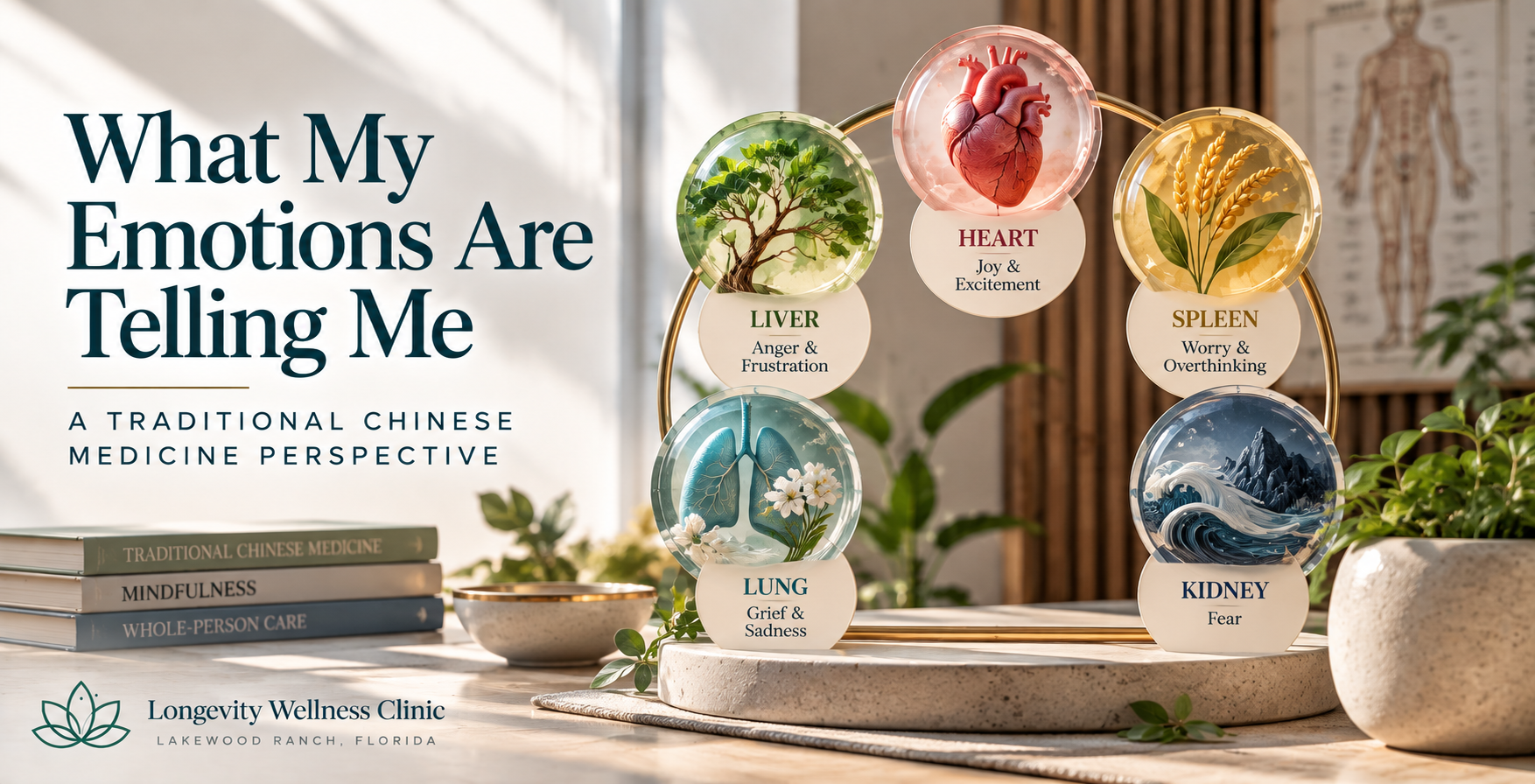
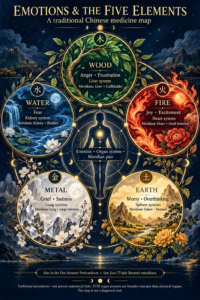
In the traditional Chinese medicine framework, five organ systems are traditionally associated with particular emotions:
Liver — Anger and frustration
Heart — Joy and excitement
Spleen — Worry and overthinking
Lung — Grief and sadness
Kidney — Fear
It is important to understand what these associations do—and do not—mean.
These are traditional TCM associations. They should not be interpreted as modern biomedical diagnoses.
The organ systems described in traditional Chinese medicine represent broader traditional patterns than the anatomical organs alone.
So if you’re angry, that does not mean your liver is damaged.
If you’re grieving, that does not mean something is medically wrong with your lungs.
If you’re afraid, that doesn’t automatically indicate a kidney problem.
Modern scientific medicine and traditional TCM theory are different frameworks. The National Center for Complementary and Integrative Health specifically notes the importance of distinguishing traditional TCM theories from questions about modern scientific evidence for particular interventions.
For me, the value of this framework is in the questions it opens up.
When Worry Shows Up, What Else Is Happening?
When worry takes over, what happens to your appetite?
When you feel frustrated, where do you hold tension?
When you’re grieving, how are you sleeping?
When you’re afraid or overwhelmed, does your body feel different?
What happens to your energy?
What helps you feel a little more like yourself?
These questions don’t require us to force every emotion into a perfect TCM category.
They’re an invitation to pay attention.
Sometimes an emotional change happens alongside a physical change. Maybe you haven’t slept well for several nights. Perhaps you’ve been skipping meals. Your stomach has been unsettled. You’re under unusual pressure at work. You’ve experienced a loss. You’re exhausted.
The physical and emotional pieces of our lives don’t necessarily happen in isolation.
That’s why, when you come into my clinic, I want to hear about all of it.
The Part That Surprised Me: Joy
Some of these traditional associations felt intuitive when I first encountered them.
Worry and an unsettled stomach?
That was easy for me to recognize.
But joy?
How could joy belong in a conversation about imbalance?
That question introduced me to the idea of equanimity: the ability to stay grounded as life moves through its highs and lows.
I don’t take that as an instruction to be less happy.
And I certainly don’t think we need to keep every emotion neatly controlled.
Instead, I think of it as making room for a feeling without necessarily having to be completely swept away by it.
You can experience happiness without desperately trying to hold onto it.
You can experience frustration without allowing one difficult moment to define the entire day.
You can recognize worry without deciding every worried thought is a prediction.
And you can experience sadness without treating sadness itself as a personal failure.
For me, that awareness creates a little room between having an emotion and being consumed by it.
It’s something I’m still practicing.
Sometimes that practice starts on the drive to work.
Your Emotions Aren’t a Diagnosis
This point deserves its own section.
An emotion is not a diagnosis.
Feeling angry doesn’t diagnose a Liver pattern.
Feeling worried doesn’t diagnose a Spleen pattern.
Feeling sad doesn’t diagnose a Lung pattern.
And these traditional associations should never be used to explain away persistent emotional distress, mental-health symptoms, or physical symptoms that need appropriate evaluation.
TCM can provide one framework for reflection, but it does not replace appropriate mental-health or medical care.
That’s especially important when emotional changes are new, severe, persistent, worsening, interfering with everyday life, or simply making you feel that you need more support.
Getting appropriate help is part of listening to yourself, too.
What Is Your Body Doing When an Emotion Appears?
Here’s something you can try without diagnosing yourself.
The next time you notice a strong emotion, don’t immediately ask:
“How do I make this stop?”
First, become curious.
Where do you notice it?
Maybe frustration comes with tight shoulders.
Maybe worry accompanies a stomach that suddenly feels unsettled.
Maybe a difficult period is also affecting your sleep.
Perhaps you’ve been so busy that you haven’t been eating consistently.
Maybe you’re exhausted and everything feels more difficult than it normally would.
Start with what is actually happening rather than what you think should be happening.
You can ask:
What am I feeling?
What do I notice in my body?
How have I been sleeping?
Have I been eating regularly?
Am I drinking enough water?
How is my digestion?
What has changed recently?
And perhaps most importantly:
What might I need today?
The answer doesn’t have to be profound.
Sometimes you need food.
Sometimes you need sleep.
Sometimes you need movement.
Sometimes you need to talk.
Sometimes you need space.
And sometimes you need professional support.
A Little Experiment for World Mental Health Day
World Mental Health Day is observed on October 10. The World Health Organization describes it as an opportunity to raise awareness of mental-health issues and mobilize support for mental health.
For 2026, WHO’s theme is “Lived experiences heard: real voices, real change.” The campaign emphasizes listening to people with lived experience and meaningfully involving them in the decisions and services that affect their lives.
That makes this a particularly fitting time to practice listening—to others, but also to what we’re actually experiencing ourselves.
I’d like to invite you to try a little experiment.
When you notice a strong emotion, pause before judging it.
You can use the traditional Chinese medicine emotion associations as a starting point, then ask yourself:
What am I feeling?
What do I notice in my body?
What might I need today?
You don’t have to find a perfect match.
You don’t need to decide which TCM organ system explains your day.
And you definitely don’t have to figure everything out by yourself.
The point is simply to pay attention with a little kindness.
Try Finishing “I’m Fine”
There’s another experiment I particularly like.
Think about how often someone asks:
“How are you?”
And before you’ve even considered the question, you answer:
“I’m fine.”
Sometimes you are fine.
But sometimes “I’m fine” is just the fastest answer.
So try giving yourself permission to finish the sentence a little more honestly.
Maybe it’s:
“I’m getting through the day, but I haven’t been sleeping.”
Or:
“I’ve been worried, and my stomach has been unsettled.”
Or:
“I’ve been frustrated, and I’m noticing how much tension I’m carrying.”
Or simply:
“I don’t feel like myself, and I’d like some help.”
That last sentence is enough.
You don’t need to arrive at an appointment with the explanation already figured out.
Bring the Whole Story to Your Next Visit
If you’ve noticed changes in your mood, sleep, digestion, tension, energy, or other aspects of how you feel, bring those observations into the conversation.
Tell us what’s actually been happening.
You can even write down three things before your appointment:
1. What have I been feeling emotionally?
2. What have I been noticing physically?
3. What has changed in my life, health, sleep, diet, stress, or routine?
Those observations may help create a more complete conversation.
At Longevity Wellness Clinic in Lakewood Ranch, Florida, our whole-person approach can include acupuncture, Traditional Chinese Medicine, applied clinical nutrition, and thoughtful discussion of the patterns you’re experiencing.
That doesn’t mean every emotion needs acupuncture.
It doesn’t mean every emotional experience has a TCM explanation.
And it doesn’t mean complementary care should replace mental-health treatment when mental-health treatment is what you need.
It means you are allowed to bring your whole experience into the room.
You Don’t Have to Figure It Out Before We Begin
One of the most important things I want people to know is this:
You don’t have to understand exactly why you’re feeling the way you’re feeling before asking for support.
You can bring the unfinished sentence.
You can bring the questions.
You can bring the worry.
You can bring the fact that you haven’t been sleeping.
You can bring the tension you’ve been carrying.
You can simply say:
“I don’t feel like myself.”
We can talk about what you’re noticing and what kind of support makes sense, including appropriate medical or mental-health care when it’s needed.
That’s what the conversation is for.
Start With a Conversation
If you’d like to learn whether our approach may be appropriate for what you’re experiencing, Longevity Wellness Clinic offers a complimentary 10-minute consultation.
Schedule your complimentary consultation or call 941-923-9355.
You don’t have to have it all figured out before we begin.
Frequently Asked Questions
What emotions are associated with organs in traditional Chinese medicine?
Traditional TCM theory commonly associates the Liver with anger or frustration, Heart with joy, Spleen with worry or overthinking, Lung with grief or sadness, and Kidney with fear. These are traditional organizing concepts rather than biomedical diagnoses.
Does anger mean something is wrong with my liver?
No. Feeling angry does not mean that your anatomical liver is damaged or diseased. The Liver concept used in traditional Chinese medicine is broader than the anatomical organ and belongs to a traditional medical framework.
Can Traditional Chinese Medicine help with emotional wellness?
TCM and acupuncture may be incorporated into a broader whole-person care plan depending on an individual’s needs. They should not be used as substitutes for appropriate mental-health evaluation or treatment.
Why does TCM associate joy with the Heart?
Within traditional Chinese medicine, emotions are considered as part of broader patterns. The association doesn’t mean happiness is unhealthy. In the reflective approach discussed here, it can open a conversation about balance, groundedness, and how we experience emotional highs and lows.
When should I seek mental-health care?
If emotional or psychological symptoms are persistent, severe, worsening, interfering with daily life, or concerning to you, seek appropriate professional care. Urgent safety concerns require immediate emergency or crisis support.