


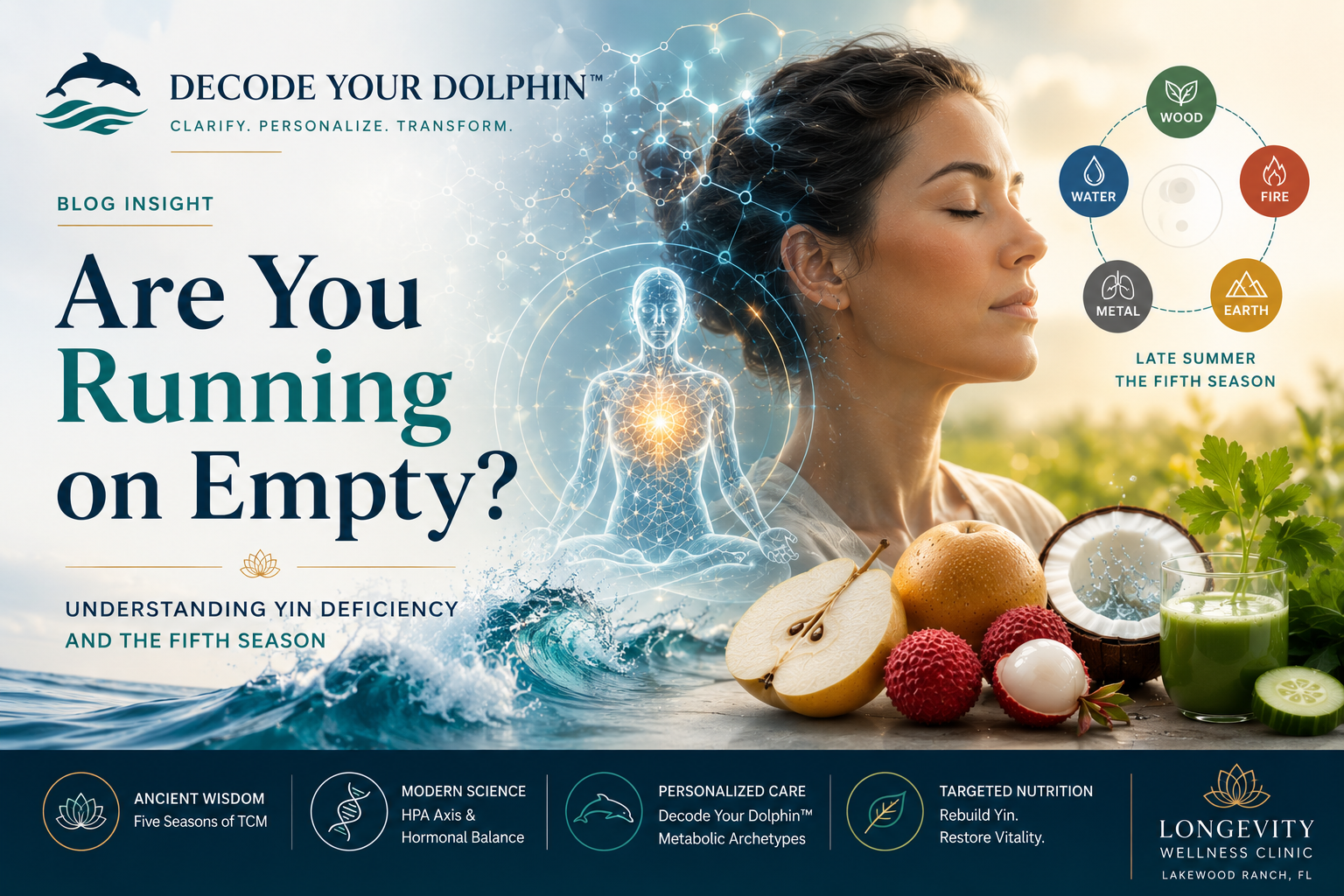
Are you feeling a deep, unshakeable exhaustion that sleep doesn’t seem to fix?
Do you find yourself wired but tired, waking at 2 or 3 AM with a racing mind, or noticing that your skin, eyes, and throat feel perpetually dry?
You might think you just need another supplement, a better sleep protocol, or a stronger adaptogen.
But what if the problem isn’t a lack of stimulation — it is a lack of substance?
In functional medicine, we often talk about adrenal fatigue and HPA axis dysregulation.
In Traditional Chinese Medicine (TCM), we call this deeper state Yin Deficiency.
And as we move through the unique Fifth Season of Late Summer, understanding how to rebuild your Yin is the most important metabolic conversation you can have right now.
Let’s explore what Yin deficiency actually is in both Eastern and Western terms, why Late Summer is the most critical time to address it, and what this means specifically for your Decode Your Dolphin metabolic archetype.
The Fifth Season: Why Asia Counts Differently
Most of us in the West think of the year in four seasons.
But in Traditional Chinese Medicine — a system refined over more than two thousand years of clinical observation — there are five.
Nestled between the intense heat of summer and the cool, contractive energy of autumn is Late Summer, a transitional period running roughly from mid-August through the fall equinox.
The Fifth Season is not an afterthought.
It is the pivot point of the entire year.
Each of the five seasons corresponds to one of the Five Elements, a foundational framework in TCM that maps the natural world onto the human body.
The table below illustrates how the system is organized.
| Season | Element | Organs | Emotion | Key Quality |
|---|---|---|---|---|
| Spring | Wood | Liver, Gallbladder | Anger / Frustration | Growth, renewal |
| Summer | Fire | Heart, Small Intestine | Joy / Anxiety | Peak Yang, expansion |
| Late Summer | Earth | Spleen, Stomach | Worry / Overthinking | Harvest, transformation |
| Autumn | Metal | Lung, Large Intestine | Grief / Letting go | Contraction, immunity |
| Winter | Water | Kidney, Bladder | Fear / Willpower | Deep rest, conservation |
Late Summer corresponds to the Earth element, which governs the Spleen and Stomach — the organs of digestion, transformation, and nourishment.
This is the season of harvest.
Just as the earth yields its crops, our bodies are tasked with digesting, absorbing, and transforming everything we have taken in throughout the year.
When the Earth element is balanced, we feel centered, grounded, and well-nourished.
When it is depleted — often because the heat of summer has burned through our fluids — we experience:
- Worry
- Overthinking
- Digestive bloating
- Profound fatigue
This is the season when our reserves are tested.
If you spent the summer burning the candle at both ends, Late Summer is when the bill comes due — in the form of Yin deficiency.
What Exactly Is Yin Deficiency?
To understand Yin deficiency, we need to translate between two medical systems that are describing the same physiological reality in very different languages.
The Eastern Explanation
In TCM, Yin and Yang are the complementary forces of all life.
Yang is the fire:
- Warming
- Active
- Stimulating
Yin is the water:
- Cooling
- Moistening
- Nourishing
- Restful
Yin represents the physical substance of your body — your blood, your cellular fluids, your hormones, and your deep energy reserves.
It is the oil in the engine, the coolant in the radiator.
When you are Yin deficient, the body has run out of its cooling, lubricating substance.
The Yang fire, no longer held in check, begins to generate what TCM calls “Empty Heat” — a low-grade, chronic internal warmth that is fundamentally different from the heat of an acute infection.
It is not a fever.
It is the heat of a system running dry.
The hallmark signs of Yin deficiency include:
- Night sweats that begin after falling asleep and stop upon waking.
- A feeling of heat in the chest, palms, and soles of the feet — what TCM calls “five-palm heat.”
- Dry mouth and throat that worsens at night.
- Dry skin, dry eyes, and brittle hair.
- Restless sleep with vivid or disturbing dreams.
- A quality of anxiety that is specifically restless — a wired, agitated feeling rather than a heavy, depressed one.
- On the tongue, a practitioner looks for a red body with little or no coating, sometimes with cracks, which indicates that the body’s fluids are depleted at a deep level.
Yin deficiency does not develop overnight.
It takes years of chronic overwork, insufficient sleep, sustained emotional stress, excessive stimulants like caffeine and alcohol, and the natural process of aging to deplete Yin to a clinically significant level.
This is why it is so common in high-achieving, driven individuals — and why it is so frequently missed.
The Western Translation
Western medicine does not have a single diagnosis for Yin deficiency, but the physiological state is well-documented across multiple systems.
When we examine Kidney Yin deficiency through a functional medicine lens, we are typically looking at the later stages of HPA axis dysfunction.
In the early stages of chronic stress, cortisol (a Yang-like, activating hormone) spikes.
Over time, the adrenal glands exhaust their precursor hormones, and both cortisol and DHEA begin to decline.
The parasympathetic nervous system — the “rest and digest” state that is fundamentally Yin in nature — becomes suppressed, leaving the sympathetic nervous system running unchecked.
The result is a person who is simultaneously exhausted and unable to rest.
In women, Kidney Yin deficiency is the direct TCM equivalent of declining estrogen during perimenopause and menopause.
Estrogen is a fundamentally Yin hormone — it plumps, moistens, and cools the tissues.
When it declines, the classic Yin-deficient symptoms of:
- Hot flashes
- Vaginal dryness
- Night sweats
- Mood instability
appear.
This is not a coincidence.
It is the same biological reality described in two different languages.
At the cellular level, Yin deficiency correlates with what Western science describes as:
- Depleted mitochondrial reserves
- Reduced cellular hydration
- Elevated systemic inflammation
The physiological signature of a body that has been running in overdrive without adequate recovery.
What This Means for Your Metabolic Archetype
In the Decode Your Dolphin system, we don’t treat a diagnosis — we treat a person.
Each of the seven marine archetypes has a unique metabolic fingerprint, and Yin deficiency expresses itself differently in each one.
Here is how Late Summer and Yin depletion affect four of our key archetypes.
Not yet sure which archetype you are? Take the quiz at DecodeYourDolphin.com before reading further — your results will make this section far more personal.
The Octopus: The Stress Responder
The Octopus runs on adrenaline.
You are the classic picture of sympathetic nervous system dominance — driven, capable, and perpetually “on.”
You likely have a history of chronic stress, and you may have been managing it with caffeine, intense exercise, or sheer willpower.
When an Octopus depletes their Yin, the Empty Heat pattern becomes severe.
The anxiety that was once manageable becomes relentless.
Sleep is elusive.
Heart palpitations appear.
You feel simultaneously exhausted and unable to stop.
This is not a cortisol problem anymore — it is a deep fluid depletion problem.
The critical mistake Octopuses make:
Reaching for more adaptogens or stimulants to push through.
Anything that further activates the sympathetic nervous system will deepen the Yin deficiency.
You cannot stimulate your way out of depletion.
The path forward:
Restorative practices like yoga nidra, gentle acupuncture, and Yin-building herbs such as Tian Wang Bu Xin Dan (Emperor’s Heart Supplement) to calm the Shen (spirit) and rebuild the Heart and Kidney Yin.
Prioritize sleep above all other interventions.
The Walrus: The Insulin-Resistant Type
The Walrus struggles with blood sugar balance, post-meal fatigue, and a tendency to carry extra weight around the middle.
The Walrus pattern is rooted in Spleen Qi deficiency — the digestive “cooking pot” is not burning hot enough to properly transform food into usable energy.
In Late Summer, the Earth element (Spleen and Stomach) is the dominant energy of the season.
This is both an opportunity and a vulnerability for the Walrus.
If you overload your already-weakened Spleen with damp, sugary, cold, or highly processed foods during this season, you will experience extreme bloating, worsened post-meal fatigue, and accelerated insulin resistance.
The heat of Late Summer can also drive a Walrus toward cold beverages and raw foods — which feel refreshing but further damage the Spleen’s digestive fire.
The path forward:
Protect your digestive fire during this season.
Favor warm, cooked, easy-to-digest meals.
Soups, stews, and lightly steamed vegetables are your allies.
Stabilize blood sugar by eating at consistent times, and support Spleen Qi with Standard Process Zymex or similar whole-food digestive support.
The Sea Turtle: The Steady One
The Sea Turtle has a naturally slower, cooler metabolism, often linked to suboptimal thyroid conversion — specifically, the inability to efficiently convert T4 into the active T3 hormone.
This is fundamentally a Yang deficiency pattern: the metabolic fire burns low.
However, when a Sea Turtle attempts to address their weight through extreme calorie restriction or over-exercising, they deplete their Yin as well as their Yang.
The result is a complex, mixed pattern: feeling cold and sluggish (Yang deficiency) while also experiencing dry skin, hair loss, and brittle nails (Yin deficiency).
This is one of the most common and most mismanaged presentations in functional medicine.
The path forward:
Stop starving your metabolism.
Sea Turtles need steady, warming nourishment — not restriction.
Incorporate mineral-rich foods like kelp and bone broth to support thyroid function.
Eat breakfast every single day to signal to your body that it is safe to burn rather than store.
Slow carbohydrates like sweet potatoes and oats support T4-to-T3 conversion without spiking blood sugar.
The Blue Whale: The Deep Restorative
The Blue Whale represents the most profound level of depletion in the Decode Your Dolphin system.
You are not just tired — you are exhausted at a cellular level.
You may have been running on empty for years, and the body has finally begun to slow down in a way that no amount of willpower can override.
The Blue Whale pattern corresponds to deep Kidney Essence (Jing) depletion in TCM — the most fundamental form of Yin deficiency.
Jing is the constitutional reserve we are born with, and it is the last resource the body draws upon when everything else has been spent.
Once Jing is depleted, recovery is slow and requires the most patient, sustained approach.
The path forward:
The Blue Whale cannot be rushed.
Think of refilling a dry well drop by drop.
Prioritize 8 to 9 hours of sleep as a non-negotiable.
Remove high-intensity exercise entirely until reserves are rebuilt.
Focus on deeply nourishing Kidney Yin foods and consider Standard Process Cataplex F or Tuna Omega-3 Oil to support cellular membrane integrity and deep tissue hydration.
Nourishing Your Yin: The Power of Hydrating Foods
To rebuild Yin, we must look to foods that generate fluids, clear heat, and moisten the body’s tissues from the inside out.
This is not simply about drinking more water.
It is about consuming foods that hold hydration at a cellular level and deliver the minerals, electrolytes, and cooling compounds that directly replenish the body’s Yin reserves.
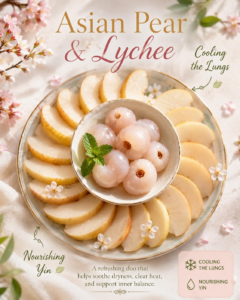
Asian Pear & Lychee: Cooling the Lungs and Nourishing Yin
Asian Pear and Lychee: a refreshing duo that soothes dryness, clears heat, and supports inner balance.
Here are four powerful ways to nourish your Yin through your daily diet.
Asian Pear (雪梨)
Asian Pear (雪梨) is one of the most revered Yin-nourishing foods in the TCM pharmacopoeia.
It is specifically classified as cooling and moistening, with a direct affinity for the Lung meridian.
Asian pear is used clinically to clear heat, soothe dry and scratchy throats, and relieve the dry, lingering cough that often appears as we transition from Late Summer into Autumn.
Its high water content and gentle sweetness make it the perfect antidote to internal dryness.
Enjoy it:
- Raw
- Poached
- Blended into a juice
Lychee
Lychee is a fascinating and nuanced fruit in TCM.
Unlike most cooling, Yin-nourishing foods, lychee is warm in nature — which makes it uniquely effective at tonifying the Blood and nourishing fluids without further cooling a system that may already be deficient in Yang.
It is particularly beneficial for the Spleen and is used to address the deep fatigue and pallor associated with Blood deficiency.
Because of its warming nature, lychee should be eaten in moderation, especially by those with signs of excess heat.
Green Juice
Green Juice — particularly blends containing cucumber, celery, and dark leafy greens — is a powerful Yin-building tool for the modern clinic.
These vegetables clear Liver heat, reduce systemic inflammation, and deliver a concentrated infusion of easily absorbable vitamins and minerals directly into the bloodstream.
From a Western perspective, the high chlorophyll content of dark greens supports liver detoxification, while the potassium and magnesium in celery and cucumber directly replenish the electrolytes lost through stress-induced sweating.
Coconut Water
Coconut Water is nature’s electrolyte solution, and it maps beautifully onto the TCM concept of replenishing Jin-Ye (the body’s essential fluids).
Naturally rich in potassium, magnesium, and sodium, coconut water restores the body’s hydration balance at a cellular level — making it far more effective than plain water for someone in a state of Yin depletion.
Research has demonstrated its effectiveness as an oral rehydration solution, comparable to clinical electrolyte formulas.
For the Octopus and Blue Whale archetypes especially, a glass of coconut water in the morning is a simple, powerful daily practice.
If you are feeling dried out, burned out, and running on fumes, pushing harder is not the answer.
Your body is not broken.
It is asking for substance.
The Fifth Season of Late Summer is not just a poetic concept — it is a clinical window of opportunity.
By understanding the unique demands of this transitional season and honoring your specific metabolic archetype, you can begin to rebuild your reserves and step into the rest of the year with grounded, steady, sustainable energy.
The question is not whether you are depleted.
The question is:
How deep does the depletion go, and what does your specific archetype need to recover?
Take the metabolic archetype quiz below to find out exactly where you stand.
And if you are ready to go deeper — to look at your labs through the lens of both functional medicine and TCM — let’s talk at your next visit.
Your reserves can be rebuilt.
It just takes the right strategy for your unique biology.
In Health and Vitality,
Dr. Cynthia Clark, AP, ACN
Founder, Decode Your Dolphin™ & Longevity Wellness Clinic
Lakewood Ranch, FL
Practitioner: Customize this sign-off with your name and clinic information. The quiz link and core archetype framework remain universal.