


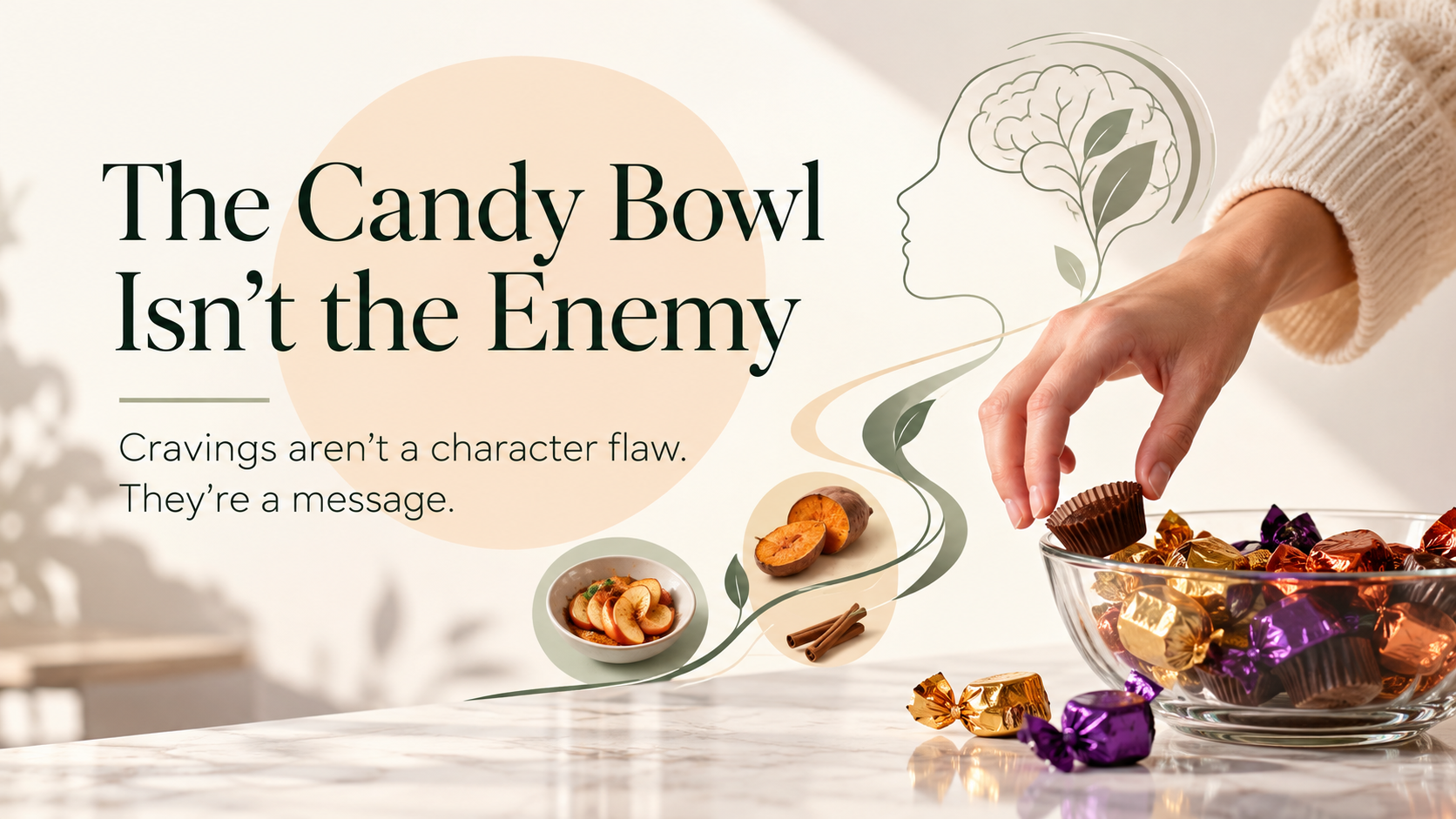
It’s 3 p.m. You’re walking through the office when you notice the candy bowl sitting on the front desk. You reach for one piece of chocolate and tell yourself, Just one. I deserve a little treat.
Twenty minutes later, you’re back.
By the third visit, you’ve collected a handful of empty wrappers and a familiar feeling begins to creep in: guilt.
Why can’t I control myself? Why do I always crave something sweet? Why is it so difficult to stop?
With Halloween approaching, candy seems to be everywhere. It’s in office break rooms, grocery store aisles, kitchen cabinets, and little bowls waiting by the front door. For many people, this season becomes an exhausting battle between temptation and self-control.
But what if we’ve been asking the wrong question?
Instead of asking, “Why don’t I have enough willpower?” perhaps we should ask, “What is my body trying to tell me?”
Here’s something important to understand: Sugar cravings aren’t necessarily a sign of weakness or a lack of discipline. They can be signals that your body is seeking energy, comfort, nourishment, or relief.
And when you begin listening to those signals rather than fighting them, your relationship with food can start to change.
Why Does Your Body Crave Sugar?
Sugar cravings can feel sudden, intense, and almost impossible to ignore. But they rarely happen without a reason.
Your brain and body constantly communicate about energy availability, hunger, stress, and emotional well-being. When something feels out of balance, cravings may become one way your body encourages you to respond.
For example, imagine you’ve had nothing but coffee for breakfast, rushed through a busy morning, and skipped lunch because of meetings.
By midafternoon, your energy begins to fade. You struggle to concentrate, your patience grows thinner, and suddenly that candy bowl looks irresistible.
Your body isn’t necessarily asking for candy. It may simply be asking for fuel.
Other times, cravings appear after a stressful conversation, a difficult day, or a poor night’s sleep. Sweet foods can become associated with comfort and temporary relief.
This doesn’t mean every craving indicates a health problem. Sometimes you simply want something sweet because it tastes good.
The important distinction is recognizing when cravings become frequent, overwhelming, or connected to patterns in your daily routine.
Rather than treating every craving as an enemy, consider it an opportunity to understand yourself better.
What Western Medicine Tells Us About Sugar Cravings
Modern nutritional science offers several explanations for why certain foods can become especially appealing when we’re tired, stressed, or hungry.
One important factor is how our bodies process different sources of sugar.
Not All Sources of Sugar Affect the Body the Same Way
Fructose is a naturally occurring sugar found in fruit, honey, and many added sweeteners. It is also part of sucrose, commonly known as table sugar.
Unlike glucose, which can be used directly by many tissues throughout the body, much of the fructose we consume is processed through the liver and intestines.
The liver can convert fructose into usable energy, stored carbohydrate, and, under certain conditions, fat.
But the source and quantity matter.
Consider the difference between eating a whole apple and drinking a large glass of sugary soda.
A whole apple contains water, fiber, vitamins, and other beneficial compounds. Its structure encourages slower eating, and its fiber contributes to fullness.
A sugary beverage, on the other hand, can deliver a large amount of added sugar quickly without providing the same feeling of satisfaction.
Over time, frequently consuming large amounts of sugar-sweetened beverages is associated with increased risks of weight gain, metabolic dysfunction, and fatty liver disease.
This doesn’t mean fruit is something to fear. Quite the opposite.
Whole fruits can be part of a balanced, nourishing diet. The goal is to recognize the difference between naturally sweet foods and highly concentrated sources of added sugar.
Stress Can Make Sweet Foods More Appealing
Have you ever noticed that your cravings become stronger during particularly stressful weeks?
There’s a biological reason this can happen.
When your body experiences stress, it activates hormonal pathways involving cortisol and other stress-related chemicals.
These responses help you manage challenges by making energy available when you need it.
However, chronic stress can also influence appetite, food preferences, and reward pathways in the brain.
For some people, this means reaching for sweet or high-calorie foods more frequently.
It’s not simply a matter of lacking discipline.
Your brain may have learned to associate certain foods with a moment of comfort during demanding situations.
Understanding that connection can help you develop more supportive ways of responding to stress.
What Traditional Chinese Medicine Notices About Sugar Cravings
Traditional Chinese Medicine (TCM) approaches cravings from a different perspective.
Rather than looking only at calories, blood sugar, or hormones, TCM considers patterns involving digestion, energy, emotions, and the body’s overall sense of balance.
In TCM philosophy, the sweet flavor is associated with the Earth element, which corresponds to the Spleen and Stomach systems.
These systems are traditionally understood to support the transformation of food into nourishment and usable energy.
It’s important to understand that the TCM Spleen is a functional concept and is not identical to the anatomical spleen described in Western medicine.
The Difference Between Gentle Sweetness and Excessive Sweetness
In Chinese medicine, sweetness itself isn’t considered harmful.
In fact, naturally sweet foods are traditionally used to support the Earth element.
Examples include:
-
Roasted sweet potatoes and winter squash
-
Warm oatmeal and millet
-
Cooked carrots and pumpkin
-
Baked apples with cinnamon
-
Naturally sweet root vegetables
These foods provide gentle sweetness alongside fiber and other nutrients.
From a TCM perspective, they may be especially appealing when someone feels depleted, overworked, or digestive discomfort.
However, excessive consumption of rich, sugary foods is traditionally believed to burden the Spleen system and contribute to patterns described as Dampness.
Dampness is a TCM concept associated with symptoms such as heaviness, sluggishness, and a sense of digestive stagnation. It is not a conventional medical diagnosis.
The traditional interpretation is that when nourishment and energy feel insufficient, the body may seek sweetness, but highly concentrated sugary foods may not provide the lasting satisfaction a person needs.
This creates an interesting question:
What if the craving is understandable, but the food you’re reaching for isn’t addressing the underlying need?
A Firehose and a Garden Sprinkler: Understanding Sugar Intake
Imagine you’re watering a garden.
A gentle sprinkler delivers water gradually, allowing the soil time to absorb it.
Now imagine aiming a powerful firehose at the same garden.
The water arrives much faster, and the soil may struggle to absorb it evenly.
This is a helpful way to picture the difference between eating whole fruit and consuming a large sugary beverage.
Both may contain fructose, but the amount, speed of consumption, and surrounding nutrients can be very different.
An apple provides sweetness packaged with fiber, water, and natural plant compounds.
A soda delivers added sugar in liquid form, often making it easy to consume a substantial amount in a short period.
The analogy isn’t a literal description of how the liver works, but it highlights an important nutritional principle:
How sugar is packaged and how much you consume matter just as much as the presence of sugar itself.
You don’t need to eliminate every sweet food from your life.
Instead, focus on choosing sources of sweetness that provide nourishment and satisfaction.
Understanding Cravings Through Three Dolphin Types
At Longevity Wellness, the Dolphin framework offers a way to reflect on different patterns of energy, stress, and metabolic health.
These Dolphin types are wellness metaphors, not medically validated diagnostic categories. They can encourage self-observation but cannot determine your blood sugar, liver health, or hormone levels.
Let’s explore three patterns that may help you recognize your own experiences.
1. The Walrus: When Your Body Is Asking for Steadier Energy
The walrus is built for survival.
Its thick layer of blubber helps store energy and provides insulation in challenging environments.
For people who identify with the Walrus pattern, common experiences might include strong afternoon cravings, fluctuating energy, or concerns about weight around the midsection.
Some individuals with these symptoms may also have changes in blood sugar, insulin sensitivity, or triglyceride levels, although these cannot be identified by body shape or cravings alone.
In TCM, a practitioner might interpret certain accompanying digestive and fatigue symptoms through patterns involving Spleen Qi deficiency or Dampness.
The practical lesson is not to punish yourself with restrictive dieting.
It’s to consider whether your body would benefit from more consistent nourishment.
Try eating balanced meals at regular intervals, including protein, fiber-rich carbohydrates, and healthy fats.
You may discover that when your energy becomes more consistent, the candy bowl feels less urgent.
2. The Silky Shark: When Rich Foods Leave You Feeling Sluggish
The silky shark is known for its streamlined body and ability to move through the ocean with remarkable efficiency.
In this wellness metaphor, the Silky Shark represents someone who notices discomfort or sluggishness after rich meals, alcohol, or sugary foods.
They may also experience irritability, digestive heaviness, or a sense of feeling stuck.
In Western medicine, persistent symptoms may warrant evaluation of digestive health and metabolic factors, including liver enzymes or blood lipids when appropriate.
In TCM, similar experiences may sometimes be interpreted through a pattern called Liver Qi stagnation.
This traditional concept describes a perceived disruption in the smooth movement of Qi, often discussed in connection with stress and emotional tension.
It should not be confused with a diagnosis of liver disease.
For the Silky Shark, the goal isn’t necessarily eliminating every indulgence.
Instead, consider reducing sugary beverages, moderating alcohol, eating balanced meals, and finding ways to release accumulated stress.
Sometimes, creating more breathing room in your routine can be just as meaningful as changing what’s on your plate.
3. The Octopus: Stress Eating on an Empty Tank
An octopus is intelligent, responsive, and constantly interacting with its environment.
In the Dolphin framework, the Octopus represents someone whose mind rarely seems to switch off.
Perhaps you’re managing several responsibilities, answering emails throughout lunch, or moving from one task to another without a moment to pause.
You may forget to eat until midafternoon.
Then suddenly, you’re exhausted, irritable, and searching for something sweet.
In some cases, long gaps between meals can intensify hunger and make quick-energy foods especially appealing.
Stress and inadequate sleep may add to the problem.
In TCM, a practitioner might consider patterns involving the Shen, a traditional concept associated with the mind and spirit.
The Octopus pattern reminds us that cravings aren’t always about the food itself.
Sometimes they’re connected to a nervous system that needs rest, a body that needs nourishment, or a schedule that leaves too little room for either.
Before reaching for another piece of candy, ask yourself:
When did I last eat a satisfying meal? Have I had enough water? Am I hungry, exhausted, or simply overwhelmed?
The answer may surprise you.
Three Gentle Ways to Respond to Sugar Cravings
You don’t need an extreme detox, a complicated meal plan, or another set of rigid food rules.
Small, consistent adjustments are often more sustainable.
1. Start Your Morning With Protein and Fiber
Breakfast can influence how satisfied and energized you feel throughout the morning.
For many adults, a breakfast containing approximately 25–30 grams of protein can be a useful target, depending on individual nutritional needs.
Consider eggs with tofu and vegetables, Greek yogurt with berries and nuts, or oatmeal paired with a protein-rich food.
Protein and fiber can support fullness, helping reduce the likelihood of becoming intensely hungry later in the day.
If you tend to skip breakfast and experience strong afternoon cravings, experiment with a balanced morning meal and notice how you feel.
2. Choose Your Sweet Treat Intentionally
There’s nothing inherently wrong with enjoying dessert.
The problem often begins when eating becomes automatic and is followed by guilt.
Instead of declaring sweets completely off-limits, try choosing them intentionally.
You might enjoy a baked apple with cinnamon, roasted sweet potato with tahini, or warm berries over oatmeal.
And if you genuinely want a piece of Halloween chocolate, enjoy it.
Sit down, taste it, and give yourself permission to appreciate the experience.
Remember that maple syrup, honey, and other natural sweeteners still contribute added sugars. They are not automatically healthier simply because they are natural.
Similarly, approved non-sugar sweeteners can have a place in some diets, although their long-term usefulness for weight management remains an area of research.
The goal is not perfection. It’s a balanced approach that works for your needs.
3. Pause and Get Curious Before Reaching for Candy
The next time a craving appears, try giving yourself a moment to check in.
Ask yourself:
Am I physically hungry? Did I skip a meal? Am I feeling stressed, bored, lonely, or tired?
If you’re hungry, eat something nourishing.
If you’re overwhelmed, perhaps you need a short walk, a few quiet minutes, or a break from your screen.
If you simply want chocolate, you can choose to enjoy it without turning the decision into a personal judgment.
The purpose of this pause isn’t to talk yourself out of eating.
It’s to understand what would genuinely help you feel better.
Why Kindness Works Better Than Willpower
So many people approach sugar cravings as a battle they need to win.
They create strict rules, promise themselves they’ll never eat sweets again, and feel defeated when those promises become difficult to maintain.
But restriction and shame can make our relationship with food more stressful.
A more compassionate approach begins with curiosity.
Instead of saying, I have no self-control, try asking, What was happening before this craving started?
Maybe you slept poorly.
Maybe lunch was too small.
Maybe you’ve been carrying more stress than you realized.
Or maybe you simply enjoyed the taste of something sweet.
None of these possibilities makes you a failure.
When you understand your patterns, you can make choices that support your health without turning food into a source of constant anxiety.
This Halloween, Let the Candy Bowl Be Just a Candy Bowl
Halloween doesn’t have to become another season of guilt, restriction, and broken promises.
You can enjoy your favorite treat and still care about your health.
You can nourish your body without following perfect food rules.
And you can recognize that cravings sometimes carry useful information without assuming every desire for sugar means something is wrong.
From a Western nutritional perspective, paying attention to meal timing, sleep, stress, and added sugar intake can support metabolic health.
From a Traditional Chinese Medicine perspective, considering nourishment, digestion, and emotional balance may offer another way to reflect on your daily habits.
These perspectives use different frameworks, but both can encourage a more thoughtful relationship with your body.
So the next time you walk past that candy bowl at 3 p.m., you don’t need to put yourself on trial.
Pause. Notice how you feel. Ask what you need.
And remember:
Cravings aren’t a character flaw. They’re a message worth understanding, not a reason to judge yourself.
Ready to Understand What Your Body Is Telling You?
At Longevity Wellness Clinic, Dr. Cynthia Clark takes a whole-person approach to wellness, considering lifestyle, stress, nutrition, and Traditional Chinese Medicine principles.
If you’re experiencing persistent cravings, fatigue, or digestive concerns, personalized guidance may help you explore contributing factors and develop supportive habits. Frequent or unusually intense cravings, especially with excessive thirst, frequent urination, or unexplained weight changes, also deserve medical evaluation.
You don’t have to figure everything out on your own.
Book a FREE 10-minute complimentary consultation call with Dr. Cynthia Clark: www.TinyURL.com/LWCRebook
Because lasting wellness begins with understanding your body, not fighting against it.