


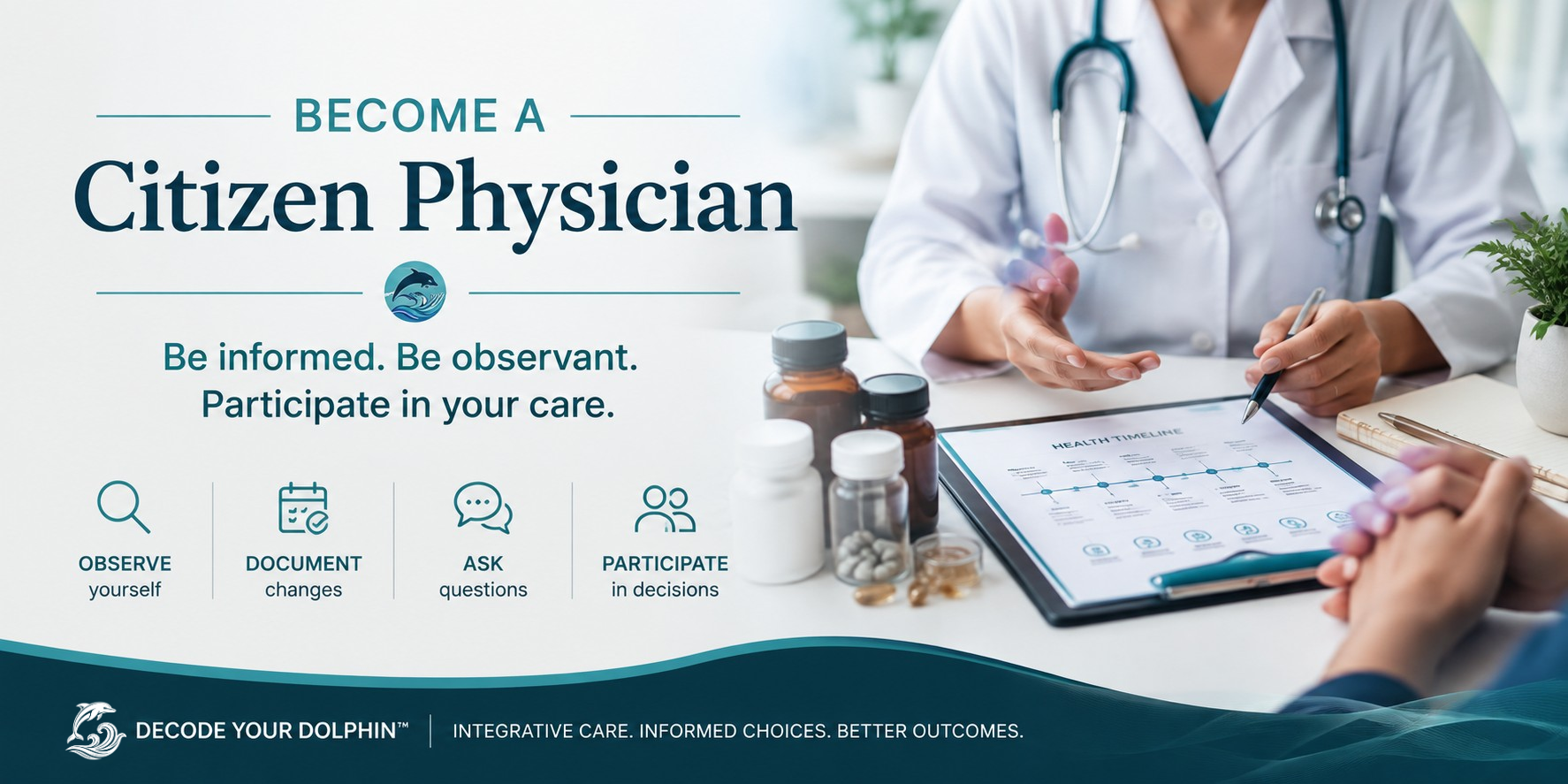
Become a Citizen Physician: How to Take an Active Role in Your Healthcare
Medication safety begins with understanding that no prescription exists in isolation from the person taking it.
A 2016 analysis published in The BMJ estimated that medical errors contribute to more than 250,000 American deaths each year. The authors argued that if medical error were recorded as a cause of death, their estimate would place it behind only heart disease and cancer at the time.
The exact number has been debated because medical error is difficult to capture consistently on death certificates, and researchers have challenged the methodology behind that estimate.
But “debated” does not mean “unimportant.”
Prescription drugs save lives. They can also cause adverse effects, interact with other medications or supplements, or require monitoring that becomes increasingly important when someone takes multiple medications.
Research involving older adults has estimated that the risk of an adverse drug reaction rises dramatically as the number of medications increases:
- Two medications: approximately 13%
- Five medications: approximately 58%
- Seven or more: approximately 82%
These figures are estimates from the literature rather than a prediction of any one person’s individual risk, but the broader relationship is important: polypharmacy is consistently associated with a greater risk of adverse drug reactions.
That should get our attention.
It does not mean, “Never take medication.”
It means:
Never become a passive passenger in your own healthcare.
The Tea Wasn’t the Whole Story
A man in my practice started drinking a new Traditional Chinese Medicine tea. About a week later, he developed severe fatigue and bloating.
The conclusion seemed obvious: new tea, new symptoms. The tea must be responsible.
But at his next visit, we examined his entire timeline.
During that same week, someone close to him was passing away. He was carrying tremendous unspoken emotional turmoil on behalf of his family.
Like many men, he was wired to protect and solve. But he could not protect his loved ones from this loss. He could not fix what had happened. His entire system was carrying something he had no power to resolve.
The tea was the most obvious change.
It was not the only change, and it was not necessarily the most significant one.
This is why we must learn to observe ourselves.
A new symptom may coincide with a medication, supplement, food, illness, interaction, emotional event, environmental exposure—or several factors working together.
The date something began matters.
But timing alone does not prove causation.
That distinction is an important part of medication safety and of understanding your body as a whole.
Why Medication Safety Requires Your Participation
Your healthcare practitioner sees you periodically.
You live in your body every day.
That gives you access to information no laboratory test or office visit can completely capture.
You know when your energy changed. You know when your sleep became disrupted. You know when your digestion suddenly felt different. You know when you started a new medication, supplement, diet, exercise program, or experienced an unusually stressful event.
Those observations aren’t a substitute for clinical evaluation.
They’re information your healthcare team can use.
This is where the idea of becoming a Citizen Physician begins.
Medication Safety Starts With Becoming a Citizen Physician
A Citizen Physician does not diagnose themselves on Google.
A Citizen Physician does not stop prescriptions because of something they saw on social media.
And a Citizen Physician does not assume that “natural” automatically means safe.
A Citizen Physician becomes an active, informed participant in every healthcare decision.
Here’s how.
Observe Yourself
Pay attention to your energy, sleep, digestion, pain, mood, appetite, cognition, and physical performance.
If something changes, notice it.
Don’t immediately decide what caused it.
Document it first.
Your practitioner sees you occasionally. You live in your body every day.
Build a Timeline
When a symptom appears, ask:
- What medication, supplement, tea, or food did I start?
- What did I stop?
- What changed in my sleep, movement, work, or environment?
- What emotional events occurred?
- Which change happened first?
- Is this a new condition, or could it be an adverse effect?
A timeline can help your healthcare team see relationships that are difficult to recognize when every symptom is considered separately.
Conduct Careful Experiments
When appropriate and safe, change one lifestyle variable at a time and record what happens.
You might experiment with sleep, hydration, meal timing, movement, food choices, or recovery strategies.
Prescription medication is different.
Never experiment with starting, stopping, or changing a prescription medication or dosage without qualified clinical guidance.
Medication safety requires collaboration, particularly when several prescriptions, over-the-counter products, herbs, or supplements are involved.
Research—But Learn How to Research
We have more health information available to us than at any other point in history.
Unfortunately, we also have more misinformation.
When researching a health question, look for reputable sources. Look for human studies, meaningful outcomes, absolute risks, study limitations, and potential financial conflicts.
Then do something most people forget:
Look for evidence that disagrees with you.
Research is not collecting articles that confirm your opinion.
It is testing whether your opinion survives good questions.
Medication Safety: Read Before You Swallow
Read your pharmaceutical labels before taking medication.
Know:
- Why you’re taking it
- What benefit is expected
- Common adverse effects
- Serious adverse effects
- Potential drug and supplement interactions
- What should be monitored
- How long you’re expected to take it
- What symptoms warrant contacting your healthcare provider
- Whether alternatives may be appropriate for you
Your pharmacist can also be an important part of your medication safety team. Bring them a complete list of your prescriptions, over-the-counter medicines, vitamins, herbs, teas, and supplements.
And remember something important:
A medication can be well studied without every possible combination of that medication, your biology, your diet, your other prescriptions, your supplements, your stress, your sleep, and your medical history being studied together.
That’s why your observations matter.
When You Take Multiple Medications, The Bigger Picture Matters
Medication safety becomes especially important as the number of medications increases.
This is sometimes discussed as polypharmacy, commonly referring to the use of multiple medications at the same time.
The issue isn’t simply that “more medication is bad.” Some people appropriately require several medications.
The concern is that as the number of medications increases, so does the complexity of possible interactions, adverse effects, and the challenge of determining which medication may be contributing to a new symptom.
Research consistently identifies polypharmacy as an important risk factor for adverse drug reactions in older adults.
This is another reason a complete medication and supplement list matters.
Participate in the Decision
Before accepting a new prescription, ask questions.
Not because you distrust your practitioner.
Because good healthcare should involve communication.
Questions might include:
- Are we certain of the diagnosis?
- Have appropriate tests been performed?
- What is the likely benefit for someone like me?
- What are the risks?
- Could one of my current medications be contributing to this symptom?
- Could we be adding a medication to manage an adverse effect from another medication?
- What alternatives are available?
- When is monitoring appropriate?
- How will we know whether this treatment is working?
The goal isn’t to challenge your healthcare team at every turn.
The goal is to understand the decisions being made about your body.
Even I Have a Coach
I know nutrition. I’ve been running races for 15 years. I’m a Certified Personal Trainer.
And I still work with a coach.
Why?
Because my coach helps me with exercise, nutrition, priorities, and observing myself honestly.
They see patterns I cannot always see from inside my own life.
I also get to draft off their success.
I still run every mile. But I don’t have to learn every lesson through injury, exhaustion, or failure.
Healthcare should work the same way.
You remain responsible for paying attention.
A qualified practitioner provides training, perspective, and guidance.
Better Medication Safety Requires Better Communication
Bring your TCM practitioner your complete medication list, laboratory results, symptom timeline, supplement list, and questions.
Ask them to help you organize your observations and communicate clearly with your physician or pharmacist when appropriate.
This isn’t Eastern medicine against Western medicine.
It isn’t natural medicine against prescription medicine.
It is collaborative care—and you are at its center.
Do not blindly reject medication.
Do not blindly accept it.
Observe. Document. Experiment safely. Research. Read every label. Ask questions. Participate.
And don’t self-diagnose when it comes to medications.
Your care team is there for a reason. Cultivate a good one, and use them.
Medication safety improves when you understand your patterns, document meaningful changes, and give your healthcare team better information to work with.
Become a Citizen Physician.