

This Friday morning, I will be standing in front of a room full of my colleagues at the Florida State Oriental Medicine Association (FSOMA) conference in Orlando.
I am presenting on a project I have spent the last twelve years building: a clinical system designed to help practitioners translate complex lab work and symptoms into clear, actionable healing paths for their patients.
I also have an article coming out this October in Acupuncture Today about why this work matters so much right now.
But before I pack my bags and head to Orlando, I wanted to share something with you.
Because the truth is, the system I am presenting on Friday was not built in a vacuum. It was built in the treatment room, listening to you.
And lately, one of the things I have been noticing most is something so simple that we almost never think about it:
How we breathe.
The connection between shallow breathing and the nervous system is easy to overlook. Yet the way we breathe can reflect whether our bodies feel calm and safe, or whether they remain caught in a state of stress.
The Forgotten Muscle: Your Diaphragm
Take a breath right now.
Where did it go?
Did your chest rise? Did your shoulders move upward? Or did your belly gently expand outward?
Most of us rarely pay attention to the mechanics of breathing.
We sit at desks for hours, compressing our core. We grip the steering wheel in traffic. We hold our breath when we read a stressful email. We tighten our stomachs. And we can carry frustration, grief, anxiety, and tension through the muscles surrounding our chest and ribs.
We do this for a day, then a week, then sometimes for years.
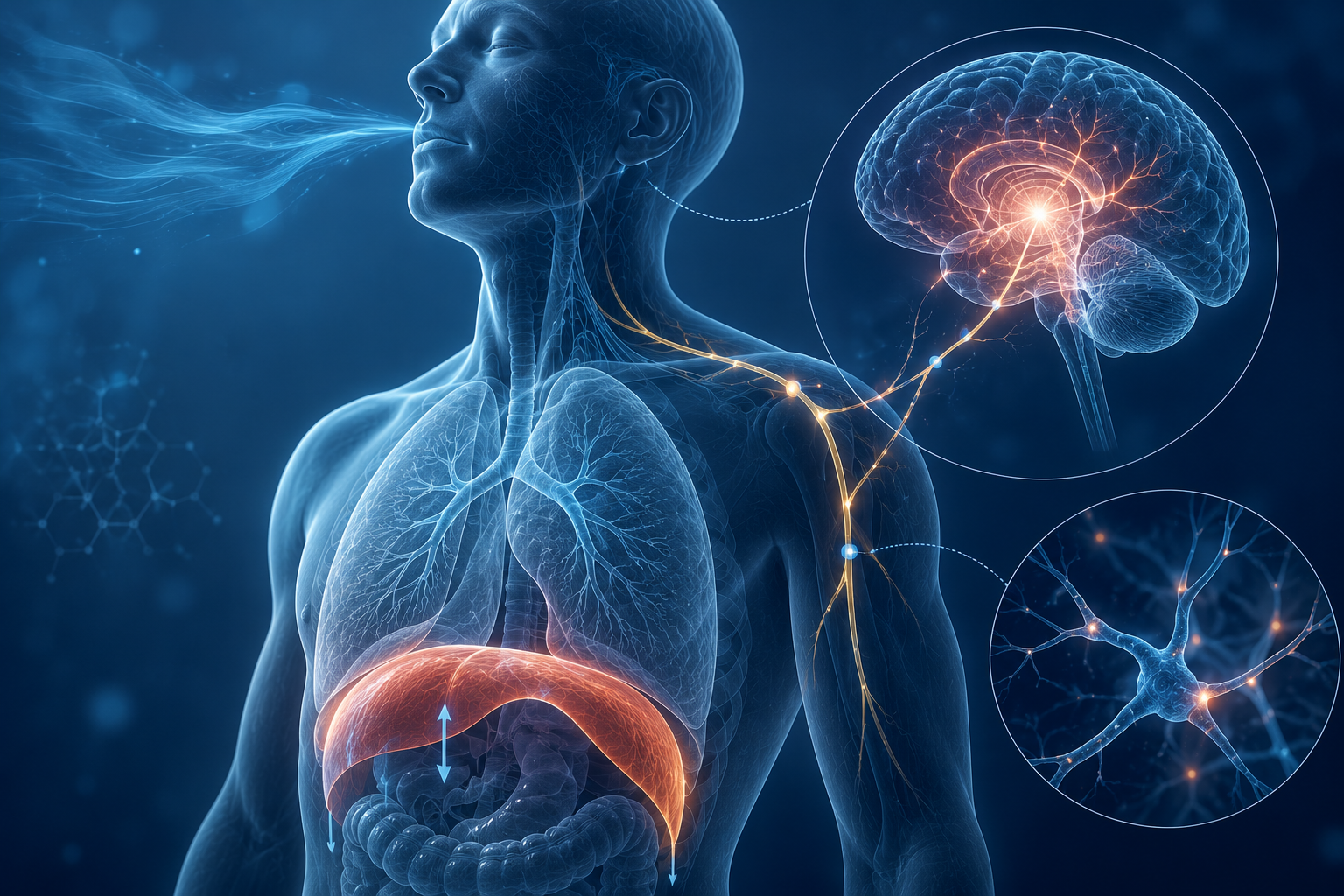
The diaphragm is the large, dome-shaped muscle beneath the lungs that plays a central role in breathing. During relaxed diaphragmatic breathing, the diaphragm contracts and moves downward as we inhale, allowing the abdomen to expand.
But when breathing becomes predominantly shallow and concentrated in the upper chest, the smaller muscles of the chest and neck become more involved.
This upper-chest breathing pattern is sometimes referred to as apical breathing.
And this is where breathing and the nervous system begin to intersect.
Shallow Breathing and the Nervous System
Breathing is unusual because it happens automatically, yet we can also consciously control it.
That makes the breath an accessible way to influence how we respond to stress.
When we are frightened, overwhelmed, rushing, or under pressure, breathing commonly becomes faster and shallower. This is part of the body’s natural stress response.
The problem is not an occasional stressful afternoon.
The concern is what happens when that pattern becomes familiar.
A body that spends too much time in a heightened state may have difficulty transitioning from sympathetic activity—the familiar “fight or flight” response, toward the parasympathetic “rest and digest” state associated with recovery and relaxation.
This is why conscious breathing practices are often incorporated into approaches designed to support nervous system regulation.
What Does the Vagus Nerve Have to Do With Breathing?
You may have heard me talk about the vagus nerve.
The vagus nerve is an important component of the parasympathetic nervous system and is involved in communication between the brain and several major organs.
Breathing patterns, particularly slower and more controlled breathing, are associated with changes in autonomic nervous system activity.
This is one reason a few intentional breaths can feel so different from the short, hurried breaths we take while answering emails, navigating traffic, or racing through a busy day.
The breath gives us something tangible to work with.
We may not be able to remove every stressor from our lives, but we can stop for a moment and change the way we are breathing through it.
The Traditional Chinese Medicine Perspective
Traditional Chinese Medicine gives us another way of understanding this relationship.
In TCM, the breath and the movement of Qi are deeply connected.
When breathing is shallow and tension accumulates through the chest, we may describe the Qi as failing to move or descend as smoothly as it should.
Rather than looking only at an isolated symptom, Chinese Medicine asks us to consider the entire pattern.
Where is the tension?
Where is the body holding?
Is there movement, or is there stagnation?
And perhaps most importantly: What does this particular person need to return toward balance?
That last question is central to Decode Your Dolphin™ because the same stressor does not necessarily create the same pattern in every person.
How Breathing Shows Up in the Decode Your Dolphin Archetypes
In the Decode Your Dolphin™ framework, different metabolic archetypes can experience stress and shallow breathing in different ways.
Here are three examples.
The Octopus: The Racing Mind
The Octopus archetype is characterized by high cognitive output, multitasking, and a nervous system that always seems to be humming.
For the Octopus, shallow breathing may accompany a tight chest, racing thoughts, and that familiar feeling of being “wired and tired.”
Because the Octopus spends so much time in the mind, bringing attention back into the body can be particularly useful.
Try this: Place one hand on your abdomen. As you inhale gently, allow your belly to expand into your hand. Instead of forcing a huge breath, focus on making it slow and comfortable.
The goal is simply to reconnect the mind with the body.
The Pufferfish: The Protective Breath
The Pufferfish archetype tends to hold tension as a form of protection.
When overwhelmed, the body may brace. The ribs can feel restricted, the abdomen tightens, and breathing can feel less comfortable or expansive.
For the Pufferfish, relaxation cannot always be forced.
The body often needs a sense of safety before it is willing to soften.
Try this: Inhale gently for four counts and exhale for six. Keep the breath comfortable rather than trying to fill the lungs as deeply as possible.
That longer, slower exhalation creates a deliberate pause in the body’s usual rhythm.
The Silky Shark: Too Busy to Breathe
The Silky Shark is driven, intense, and constantly moving toward the next objective.
The Shark may not notice they are holding their breath because they are already focused on the next task.
For this archetype, breathing often works best when it has structure.
Try box breathing: Inhale for four counts, hold for four, exhale for four, and hold for four.
A structured practice gives the Shark’s active mind something specific to do while creating a moment to stop and reset.
A Simple Breathing Practice You Can Try Today
You don’t need a complicated routine.
Sit comfortably and release your shoulders.
Place one hand over your abdomen.
Breathe in slowly through your nose and notice whether your abdomen gently expands.
Then allow the exhale to be slow and relaxed.
Repeat for several comfortable breaths.
If you become lightheaded or uncomfortable, return to your normal breathing pattern.
The goal isn’t to breathe as deeply as possible.
The goal is awareness.
Sometimes noticing that you’ve been holding your breath is the first step toward changing the pattern.
Before I Head to Orlando
If you don’t know your Decode Your Dolphin™ archetype yet, you can take the quiz here and begin exploring how your individual patterns may influence the way you experience stress, energy, and recovery.
As I prepare to share this framework with my colleagues on Friday, I am overwhelmed with gratitude.
Everything I know about healing has been shaped by years of walking alongside my patients—listening, observing, asking questions, and continuing to learn.
Thank you for trusting me with your care, for asking hard questions, and for allowing me to learn from you and with you all these years.
It is the honor of my life to be your practitioner.
For now, take one slow breath.
Let your belly expand.
Drop your shoulders.
And notice what changes.