


Why Cardio Stops Helping After 40 and How the Best Weight Loss Program in Florida Looks at Movement Differently
For many women and men after 40, weight gain feels confusing not because it happens, but because the usual solution no longer works. The instinct to do more cardio often leads to more frustration, especially when weight continues to gather around the abdomen despite consistent effort.
This experience is common. It is also misunderstood.
What has changed is not your motivation or your discipline. What has changed is how your body interprets stress, effort, and recovery at this stage of life.
At Longevity Wellness Clinic, many people seeking the best weight loss program in Florida arrive after years of “doing everything right.” They are active. They exercise regularly. They push harder when results slow. And yet their bodies respond by holding on more tightly.
Understanding why requires shifting attention away from calories burned and toward how the nervous system processes load.
How the Body Responds to Exercise After 40
In earlier decades, steady or intense cardio often produced reliable results. The body recovered quickly. Stress hormones rose during exercise and dropped afterward. Muscles rebuilt efficiently. Sleep restored balance.
After 40, that rhythm changes.
Hormonal buffering decreases. Recovery slows. Sleep becomes lighter or interrupted. Cortisol, the primary stress hormone, stays elevated longer. The nervous system becomes more sensitive to cumulative demand.
This means that the same workout that once supported metabolism may now be interpreted as excessive strain.
From a physiological standpoint, exercise is a stressor. That is not a problem when the system has sufficient reserves. But when the body is already managing work pressure, emotional load, sleep debt, and hormonal transitions, additional stress can tip the balance in the wrong direction.
Why Excessive Cardio Can Increase Belly Weight
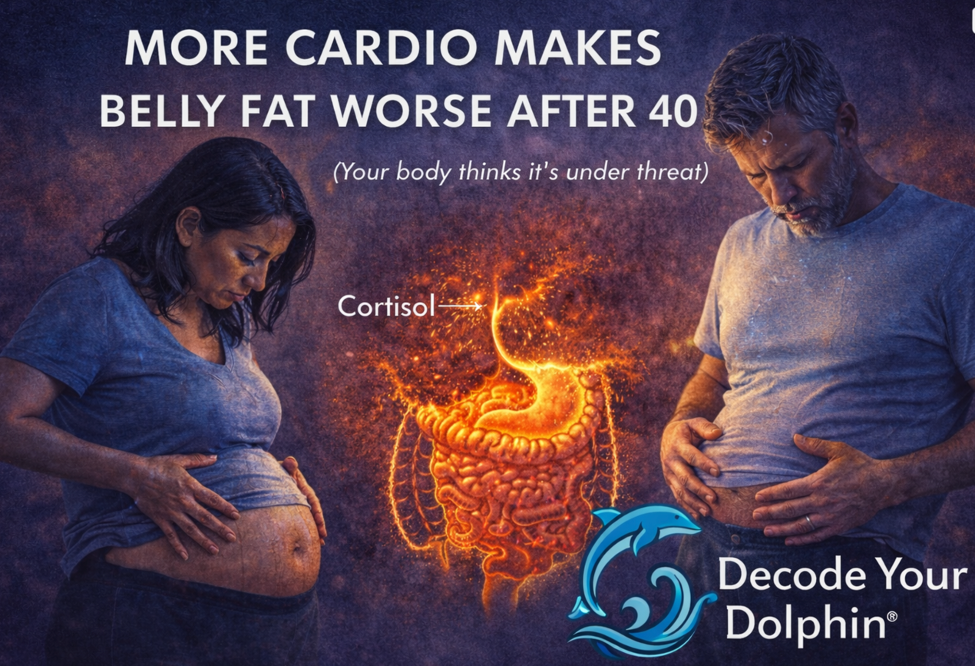
Cardio raises heart rate and mobilizes energy. It also increases cortisol. In a well supported system, cortisol returns to baseline after training. In a midlife system already under load, that shutdown does not always happen.
When cortisol remains elevated, the body prioritizes energy storage near the vital organs. Abdominal fat tissue is especially responsive to stress hormones, which is why weight often shifts toward the belly even as activity levels increase.
This is not the body resisting your effort. It is the body responding logically to signals of ongoing demand without adequate recovery.
For women in perimenopause and menopause, declining estrogen affects insulin sensitivity and stress tolerance. This makes blood sugar swings and cortisol spikes more impactful. For men, gradual testosterone decline reduces muscle support and metabolic flexibility, allowing stress hormones to play a larger role.
In both cases, the nervous system becomes the primary driver of weight patterns.
Why Pushing Harder Often Makes Things Worse
When results slow, most people respond by increasing effort. More cardio. Longer sessions. Fewer rest days. Tighter food rules.
Unfortunately, this often reinforces the very signal the body is reacting to.
From the nervous system’s perspective, increased exertion layered onto insufficient recovery looks like sustained threat. The body adapts by conserving energy more aggressively. Fat storage increases. Muscle recovery slows. Motivation drops.
This is why many people feel betrayed by their bodies after 40. They are doing more of what once worked and getting the opposite outcome.
The issue is not effort. The issue is signal.
What the Best Weight Loss Program in Florida Focuses On Instead
The best weight loss program in Florida does not ask how many calories you burned. It asks what message your body received.
At Longevity Wellness Clinic, we approach weight loss as a systems issue, not a willpower challenge. The goal is to restore communication between the nervous system, hormones, metabolism, and recovery.
This begins with changing how movement is used.
Instead of relying heavily on endurance based cardio, we prioritize strength, stability, and nervous system regulation. Strength training supports muscle mass and metabolic health without the same cortisol burden. Gentle, rhythmic movement supports circulation and recovery. Rest is treated as a biological requirement, not a reward.
Cardio is not eliminated. It is dosed appropriately, timed carefully, and matched to the individual’s current capacity.
Why Safety Matters More Than Burn
Weight loss after 40 happens most reliably when the body feels safe. Safety is not an emotional concept here. It is physiological.
When blood sugar is stable, sleep is supported, stress hormones are regulated, and recovery is consistent, the body no longer needs to store energy defensively. Fat loss becomes a byproduct of balance rather than a battle.
This is why restriction and overtraining often fail. They increase the perception of threat. The nervous system responds by tightening control rather than releasing weight.
The best weight loss program in Florida works in the opposite direction. It reduces internal noise so the body can recalibrate naturally.
A Smarter Way Forward
If you are exercising consistently and not seeing results, the solution is not necessarily more intensity. It may be better timing, better recovery, or a different form of movement altogether.
Progress after 40 comes from precision, not punishment.
When movement supports regulation rather than escalation, cortisol settles. Energy improves. Weight begins to shift without constant effort.
This is not about doing less. It is about doing what your body can respond to now.
Finding Support That Matches Your Physiology
Longevity Wellness Clinic offers an integrative approach for individuals seeking the best weight loss program in Florida. We work with clients both in person and virtually throughout the state.
Our programs combine functional nutrition, acupuncture, Traditional Chinese Medicine, nervous system regulation, and personalized movement guidance. Each plan is designed to match the body’s current context rather than forcing it into outdated expectations.
Because lasting weight loss does not come from fighting your body. It comes from understanding how it works now.
If your current routine feels like it is pushing against resistance instead of creating momentum, it may be time to change the signal.